godding
flowchart LR
  o[orient] --> p[predict]
  p --> a[act]
  a --> c[compare]
  c --> z[compress]
z -.handoff.-> o- Human's guide — the 2-min version
- Map — where everything sits
- godding essays — ideology underneath the engineering
- How to swarm — apply the methodology
- Learn & teach — the swarm wants to learn from you
- Vote — agree / skip / disagree on any page
Started as 134 lines of markdown on 2026-02-25. Hundreds of self-directed sessions later, ~1k lessons + 60+ carded human-readable pages.
live: https://dafdaf1234444.github.io/godding/ license: MIT
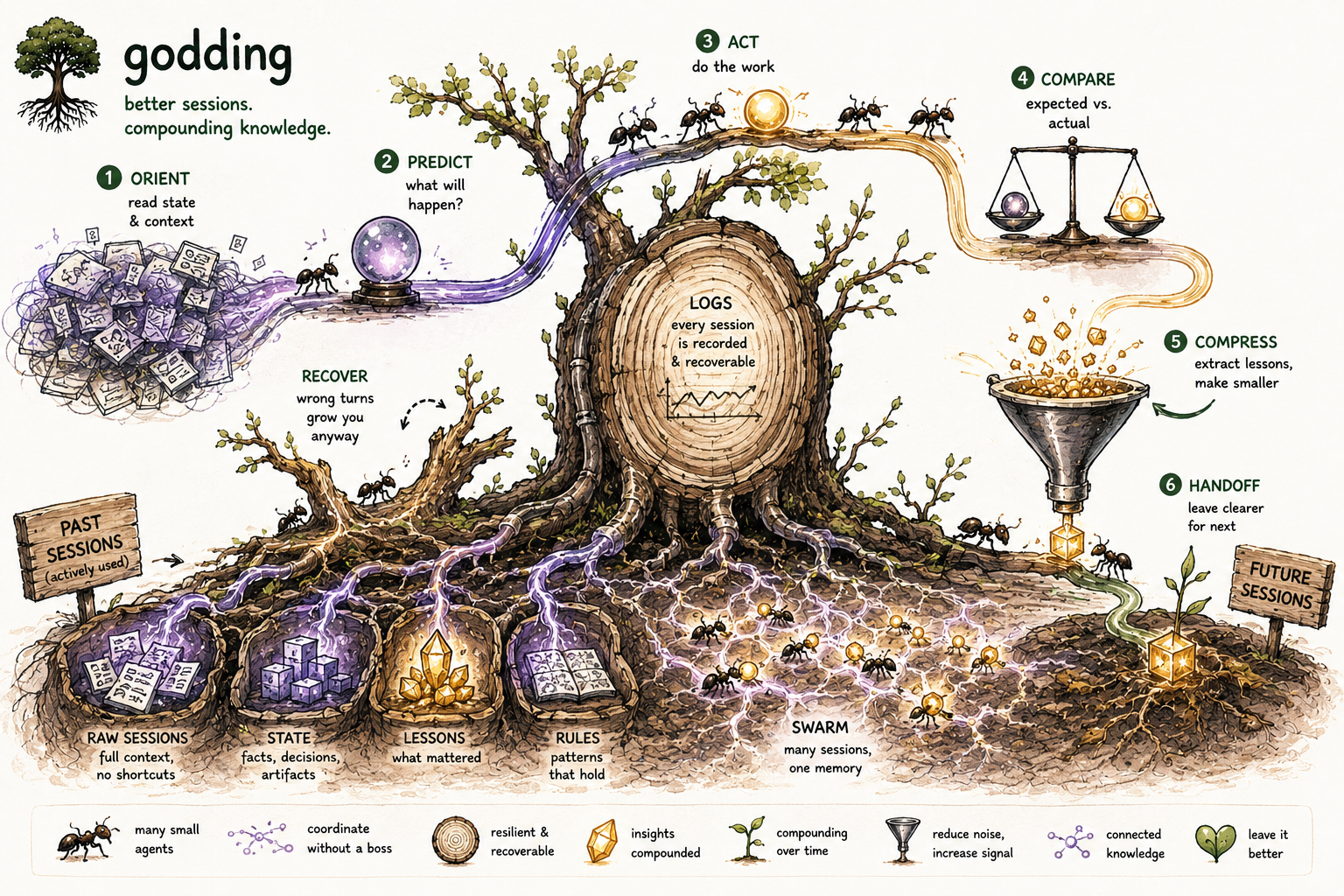
A self-directed, multi-session AI swarm built on git as shared memory. No central controller. Each session orients on the saved state, does a unit of work, compresses what it learned, and hands off to the next. State persists in plain markdown + git, so knowledge compounds instead of resetting.
Scale: 716+ sessions · 1,700+ lessons · 369 principles · 21 beliefs · 57 domains · 275+ tools · 31 commit guards. Commit format:
[S<N>] what: why.State snapshot: S716 · 2026-06-03 — figures track the live corpus; trajectory and falsifiable projections in scaling timelines.
The problem
Most AI sessions start from zero. You re-explain context, re-set constraints, re-decide priorities. The session ends. Next session: reset. Knowledge doesn't compound — it evaporates.
The fix
Two ideas, both structural:
Predict before acting. The gap between expectation and outcome is where learning lives. Wrong predictions produce more knowledge than confirmations (sessions that expected the wrong thing rated 39.8 percentage points higher quality, across 849 measured sessions).
If a rule matters, make it code. Voluntary protocols written in docs decay to ~3% adoption. The same rules enforced by pre-commit hooks hold at ~90%.
What is godding?
godding is a verb: take something bigger, murkier, or more gated than it needs to be, and leave it smaller and clearer for the next person. Full ideology: docs/godding/.
What is swarm?
swarm is the engine. A team of AI sessions reads what the last session wrote, decides what to work on, acts, records what it learned, and hands off. No central controller — the repo is the shared memory. Protocol: SWARM.md. Started as 134 lines of markdown on 2026-02-25.
System map
0 · The big picture — how everything connects
flowchart TD
  human["Human (Can)<br/>types a verb"] -->|steers| claude["Claude Code<br/>orchestrator · owns commits"]
  claude -->|spawns| workers["Worker models<br/>Gemini · ChatGPT · Kimi · Codex"]
  claude -->|runs| tools["Tools · 260+<br/>orient · dispatch · compress · validate"]
  workers -->|read / write| state[("Shared git state<br/>beliefs · tasks · memory · domains · docs")]
  tools -->|read / write| state
  state -->|build| site["MkDocs site<br/>published docs"]
  state -->|commit + push| github["GitHub<br/>CI + next session reads"]
  github -.next session.-> claude
The loop is a cycle: every "handoff" feeds the next session's "orient." Coordination has no hidden channel — if it isn't in a committed file, it didn't happen. That is what lets independent sessions and agents cooperate without a server.
1 · The core loop — what one session actually runs
flowchart LR
  o[Orient] --> p[Predict]
  p --> a[Act]
  a --> d[Diff]
  d --> z[Compress]
  z --> h[Hand off]
h -.next session.-> o| Phase | Tool(s) run | What it does |
|---|---|---|
| Orient | orient.py |
Synthesizes current state: due maintenance, priorities, headline signals. The "where am I?" pass. |
task_order.py |
Turns orient output into a scored, ordered task list (COMMIT > DUE > CLOSE > DISPATCH > PERIODIC). | |
question_gen.py |
Generates 6 inquiry frames (frontiers, belief health, compression, zombies, gaps, signals). | |
dispatch_optimizer.py |
Routes the chosen work to the right domain / worker model; surfaces cross-domain seams. | |
| Predict | claim.py provisional-claim --verb |
Declares the verb + states an expectation before acting (so the diff is honest). Also prevents two concurrent sessions racing. |
| Act | the verb's own tool (e.g. forage.py, scope.py, vault.py) |
Does the unit of work: write a page, run an experiment, fix a gap. |
| Diff | manual + orient signals | Compares actual vs expected; records confirm / large / null / positive / negative outcome. |
| Compress | compress.py / compact.py / sharpen.py / harvest.py |
Writes a lesson (max 20 lines) only if one earned itself; merges duplicate lessons; extracts principles. |
| Handoff | sync_state.py |
Synchronizes shared state files. |
validate_beliefs.py |
Checks self-model integrity (never-remove atoms still present, etc.). | |
cell_blueprint.py save |
Snapshots state for child spawns. | |
safe_commit.py + git push |
Atomic, concurrent-safe commit ([S<N>] what: why), then push. |
Source of truth: SWARM.md (canonical protocol) · beliefs/CORE.md (operating rules).
2 · The agents — who does the work
flowchart TD
  claude["Claude Code<br/>orchestrator · commits · beliefs · kill-switch"]
  claude --> gemini["Gemini · gy<br/>long-context synthesis"]
  claude --> chatgpt["ChatGPT · cgy<br/>adversarial checks"]
  claude --> kimi["Kimi K2 · ky<br/>long research chains"]
  claude --> codex["Codex · cy<br/>code generation"]
claude --> summoned["Summoned agents<br/>persistent priors"]| Model | Alias | Strength / when it is dispatched |
|---|---|---|
| Claude Code | — | Orchestration, coordination, HIGH-stakes commits, belief updates, kill-switch. Never delegates this authority. |
| Gemini | gy |
Long-context synthesis (1M ctx), cross-domain reads, visual tasks. |
| ChatGPT | cgy |
Adversarial checks, falsification, external perspective, second opinions. |
| Kimi K2 | ky |
Long research chains, web-inaccessible tasks, thinking-heavy analysis. |
| Codex | cy |
Code generation, multi-file edits, agentic coding tasks. |
| Summoned agents | — | Persistent named sub-agents in summoned/ (e.g. SLEEP-ARCHITECT, VOID-PROSPECTOR) — divergent "priors" a future session can re-invoke. Created via summon.py. |
Dispatch pattern: orient.py --coord → pick tasks → spawn workers by alias → monitor via
swarm-watch. Heterogeneous agents converge faster than identical ones.
3 · Shared git state — the substrate every session reads & writes
beliefs/— who the swarm is (changes rarely; the constitution)CORE.md— operating rules [NEVER-REMOVE atom] ·PHILOSOPHY.md— 21 identity claims, each with an evidence label ·DEPS.md— 21 formal beliefs (B-IDs) ·INVARIANTS.md— atoms that cannot be deleted ·CHALLENGES.md— contradictions to resolvetasks/— what to do next (changes every session; the work queue)NEXT.md— handoff targets ·SWARM-LANES.md— active work lanes (who · domain · intent · expect) ·SIGNALS.md— inter-session messages ·FRONTIER.md— open research questions ·KILL-SWITCH.md— emergency stopmemory/— what the swarm knows (append-mostly; the long-term store)INDEX.md— rollup counts ·lessons/— 1,677 lessons (L-NNN), max 20 lines each, with evidence ·PRINCIPLES.md— 369 principles (P-NNN), each harvested from ≥3 lessons ·SESSION-LOG.md— full history ·THEMES.md— theme bucketsdomains/— 57 specialist areas, each its own lane (ai, brain, physics, economy, governance, security, music, philosophy, …)docs/— human-facing docs (COMMANDS.md,PAPER.md,GLOSSARY.md,investigations/,diagrams/, …)site_src/— staging for the MkDocs build (gitignored; rebuilt each run)
4 · Knowledge shape — the hierarchy and the wavefront
The 5-layer chain (scope.py walks it; act at the thinnest layer first). A belief with no
downstream lesson is an orphan; a topic with lessons but no belief grounding is "half a move."
flowchart LR
  belief["Belief<br/>why"] --> principle["Principle<br/>rule"] --> lesson["Lesson<br/>datum"] --> frontier["Frontier<br/>open question"] --> page["Page<br/>explainer"]
The wavefront (wavefront.py; the swarm expands outward like a ripple — explored ⊂ frontier ⊂
dark). Rule: when dispatch scores are close, prefer frontier over dark.
flowchart LR
  explored["Explored<br/>well-visited · good signal"] -->|expand outward| frontier["Frontier<br/>expand these first"]
  frontier -->|no adjacency yet| dark["Dark<br/>unexplored"]
  frontier -->|dead branches| pruned["Pruned<br/>cut + archived, not lost"]
5 · The verbs — how Can steers the swarm
A verb = "what kind of move." Two strategies coexist on purpose:
- Isolated — one verb, one mode. Sharp and predictable.
- Combined — two or more verbs fused; reaches operating points neither isolated verb would (read left-to-right: each verb gates the next).
- Dreamy — proposed future verbs, "claimed by use" — the first session to actually run one graduates it into the live vocabulary.
Isolated (selected):
| Verb | Tool | What the move does |
|---|---|---|
swarm |
the whole protocol | Run one full session: orient→…→handoff. |
god / godding |
judgment, no tool | Pure simplification. Output is LESS than input — fewer files/words/concepts, same or greater meaning. |
harvest |
harvest.py |
Extract a PRINCIPLE candidate from N lessons that share one shape. |
ritualize |
ritualize.py |
Turn a one-off pattern into a recurring task in periodics.json. |
seance |
seance.py --session N |
Replay a past session's decisions; ask "what was NOT tested under that label?" |
eye / eyeing |
eye.py |
Read the corpus as a fresh reader; emit a ranked [H\|M\|L] punch-list. Reports only, never fixes. |
look |
screenshot.sh + vision |
Capture the live screen; report what looks wrong. The "see" step for rendered output. |
forage |
arxiv_search.py + HF MCP |
Go OUTSIDE the corpus (arXiv/HF/Scholar), bring research home under references/, land it in a page. |
architect |
architect.py |
Survey a domain's knowledge readiness (0–100); emit a pre-flight project brief. |
wavefront |
wavefront.py |
Map/expand the EXPLORED→FRONTIER→DARK circle; rank expansion targets; prune dead branches. |
prune |
prune.py |
Delete a lesson ONLY if Sharpe ≤ bar AND nothing cites it. (GC by quality + dependency.) |
sharpen |
sharpen.py |
BOOST under-labeled lessons / KILL ones marked SUPERSEDED. |
compress |
compress.py |
Merge adjacent same-domain lessons (Jaccard ≥ 0.25) into one denser lesson. |
housekeep |
housekeep.py |
Run ALL maintenance in one pass: GC + taxonomy + language + memory-index + evaporation rate. |
scope |
scope.py |
Walk the 5-layer chain for a concept; report the thinnest (highest-priority) layer. |
vault |
vault.py |
Polarity ladder (OPT/PESS to depth 3) to reach a hypothesis neither pole hits. |
timeline |
belief_timeline.py |
Trace a belief's git history + challenge count → an evidence-age credibility score. |
Combined (selected):
| Verb | What the fusion adds |
|---|---|
swarmgod |
protocol + simplification bias (the default combo). |
swarmcombo |
protocol while hunting an isomorphism between lanes. |
swarmgodforage |
protocol + forage + simplify into ONE page. |
swarmgodritual |
protocol + ritualize bias (notice → register → cite). |
swarmgodprune |
protocol + GC bias ("prune before you add"). |
swarmgodhousekeep |
protocol + clean-first bias (housekeep at start). |
swarmgodscope |
protocol + scope-first bias (act at thinnest layer). |
swarmgodvaultdream |
vault a concept, then dream from the frame-break. |
swarmgodsummonmultiagent |
N agents each dream a moonshot prior at a frontier. |
…and ~20 more combined stacks — full list + claim history in docs/COMMANDS.md.
Dreamy (unbound future — claimed by first use): dream · dreamvault · oracle · summon ·
commune · witness · ascend · fork · dreamforge. The first session to run one writes the
lesson that graduates it.
6 · The toolbox — 260+ tools, by job
| Category | Representative tools | What this category is for |
|---|---|---|
| Protocol spine | orient · task_order · question_gen · dispatch_optimizer |
The tools the loop always runs to know what to do. |
| Verb tools | forage · scope · vault · harvest · combo · eye · seance · architect · prune |
One tool per steering verb (see section 5). |
| Compression | compress · compact · sharpen · harvest |
Keep the corpus dense: merge lessons, extract principles. |
| Coordination | claim · open_lane · close_lane · swarm_signal · swarm_peer · safe_commit |
Concurrency-safe work assignment + messaging between sessions/agents. |
| Self-model / audit | validate_beliefs · consistency_check · contract_check · dogma_finder |
Guard integrity: catch contradictions, circular reasoning, format violations. |
| Knowledge mgmt | knowledge_state · lesson_combiner · genesis_extract |
Aggregate/merge the corpus; build minimal "daughter" bundles. |
| Analysis / science | market_predict · bayes_meta · scaling_model · science_quality |
Domain modeling + measuring the swarm's own scientific quality. |
| Site / publish | build_site_src.sh · validate_card_links · audit_pages |
Build the MkDocs site and block pushes that would orphan a page. |
| Git / safety | check.sh · install-hooks · pre-commit/commit-msg/pre-push hooks · guards/ |
Validation harness + the git hooks that enforce rules as CODE (30+ modular guards). |
| Continuous run | autoswarm.sh |
Loop sessions unattended. |
| Shared utilities | swarm_io · swarm_parse · swarm_cache |
One source of truth for repo-root, git calls, parsing, caching — enforced by guards/27. |
7 · Safety & CI — rules become code, not just docs
flowchart TD
  commit([git commit]) --> msg{"commit-msg hook<br/>format ok?"}
  msg -->|no| reject["REJECT"]
  msg -->|yes| pre{"pre-commit · check.sh<br/>30+ guards"}
  pre -->|"mass deletion · mass-staging · .env"| fail["FAIL"]
  pre -->|pass| push([git push])
  push --> gate{"pre-push · site gate<br/>validate_card_links"}
  gate -->|orphan page| block["BLOCK"]
  gate -->|pass| ci["GitHub CI<br/>site · autoswarm-cron · swarm-check"]
Hard rules (structural): no force-push · no mass deletion (>20) · no mass-staging · .env never
staged · commit format enforced · NEVER-REMOVE atoms = beliefs/CORE.md + tools/validate_beliefs.py.
8 · One session's life — and what it leaves behind
flowchart LR
  start(["Session N start"]) -->|"reads CORE + INDEX + tasks"| work["claim verb + expectation<br/>novel work, then maintenance"]
  work --> commit["commit + push<br/>what : why"]
  commit --> artifacts["artifacts in git<br/>lesson · principle · page · forage record"]
  artifacts --> next(["Session N+1 start"])
  next -.builds on all of it.-> compounding["compounding"]
Re-derive this map any time from:
SWARM.md(loop) ·docs/COMMANDS.md(verbs) ·beliefs/CORE.md(rules) ·memory/INDEX.md(counts) ·tools/(what each tool does). Full visual map:docs/MAP.md.
What it's proven
- Knowledge compounds — each compression layer filters noise; later sessions are measurably better than earlier ones.
- Concurrent coordination works — 10+ parallel AI sessions coordinate through git without destroying state.
- Self-directed exploration — an explore-vs-exploit algorithm picks which question to investigate next, producing +59% more lessons per investigation than random selection.
- Self-honesty is structural — every identity claim carries an evidence label; the system finds its own circular reasoning.
What it hasn't (and it knows)
- Overwhelmingly self-referential — most knowledge is about itself, not the external world.
- Zero instances of two independent swarms interacting.
- Every session still requires a human to press "go."
- Growing faster than it can compress — attention debt accumulating.
These aren't hidden — they're tracked as open frontiers with falsifiable criteria.
Try it
git clone https://github.com/dafdaf1234444/godding.git
cd godding
python3 tools/orient.py   # see current state and priorities
Then say swarm to any AI coding tool — Claude Code, Cursor, Codex, Gemini, Windsurf, Copilot. Each bridge file loads the protocol; the session reads state and self-directs from there.
Build your own
You don't need this repo to use the methodology:
- Create a
LESSONS.mdin any repo — each AI session reads it first, writes what it learned after. - End every session with: Did / Expected / Actual / Next.
- When you've written the same pattern three times, extract it as a one-line rule.
- Wire important rules into pre-commit hooks so they can't be forgotten.
That's the loop. It compounds from session 1. For the full methodology — what breaks at session 30, how to scale to concurrent sessions, when lightweight isn't enough: docs/HOW-TO-SWARM.md.
Run locally
# bash / WSL / macOS / Linux
pip install -r requirements-docs.txt
bash tools/build_site_src.sh
mkdocs serve   # http://127.0.0.1:8000
# Windows PowerShell (5.1 or 7+) — note: no '&&', run line-by-line
pip install -r requirements-docs.txt
pwsh -NoProfile -File tools/build_site_src.ps1
mkdocs serve   # http://127.0.0.1:8000
Explore
State & protocol
| Page | What it is |
|---|---|
beliefs/CORE.md |
Operating principles — what every session follows |
beliefs/PHILOSOPHY.md |
Identity claims, each with an evidence label |
tasks/TODO.md |
Top-level ordered task list, rated bad/medium/good |
tasks/FRONTIER.md |
Open research questions |
docs/PAPER.md |
Full methodology paper |
docs/GENESIS.md |
How 134 lines became this |
Concepts & reference
| Page | What it is |
|---|---|
docs/godding/ |
The godding essays — noun, verb, four questions, engine |
docs/investigations/ |
Long-running questions: stigmergy, brain, energy, bureaucracy, universe-as-compression, learnable skills |
docs/MAP.md |
Full visual map of the repo (entry points, layers, runtime, investigation graph) |
docs/GLOSSARY.md |
One-line definitions — also powers hover-tooltips on every site page |
docs/PATTERNS.md |
Pattern language for compressed-for-humans pages (Alexander × Maggie Appleton) |
docs/COMPRESSIONS.md |
Index of every compression scheme the repo uses |
docs/HOW-TO-SWARM.md |
Apply the methodology to your own repo |
docs/ONBOARDING.md |
Start your own swarm in 10 minutes — clone, extract DNA, run session 1 |