Electron management¶
flowchart LR
  sun[sun · 174 PW] --> plants[plants · 130 TW chem]
  plants --> food[food chain]
  food --> body[human · 100 W]
  body --> atp[ATP · ~70 kg/day cycled]
  atp --> work[muscle · brain · heat]
  sun --> renew[solar/wind]
  fossil[fossil C-bonds] --> grid[grid · 3 TW elec]
  uranium[U / Th] --> grid
  renew --> grid
  grid --> motor[motors · 50%]
  grid --> heat[heat · 20%]
grid --> light[light · ICT · 30%]- food as fuel — the input side at body scale
- body as engine — the engine that burns it
- energy & attention — what the watts buy in cognition
- sustainability — the long-horizon ledger
Investigation · rating: medium. Energy is the most-conserved quantity in physics and the most-mis-measured quantity in everyday life. The compact representation matters because it lets you compare 'a coffee' to 'a marathon' to 'a small data center' on one ledger.
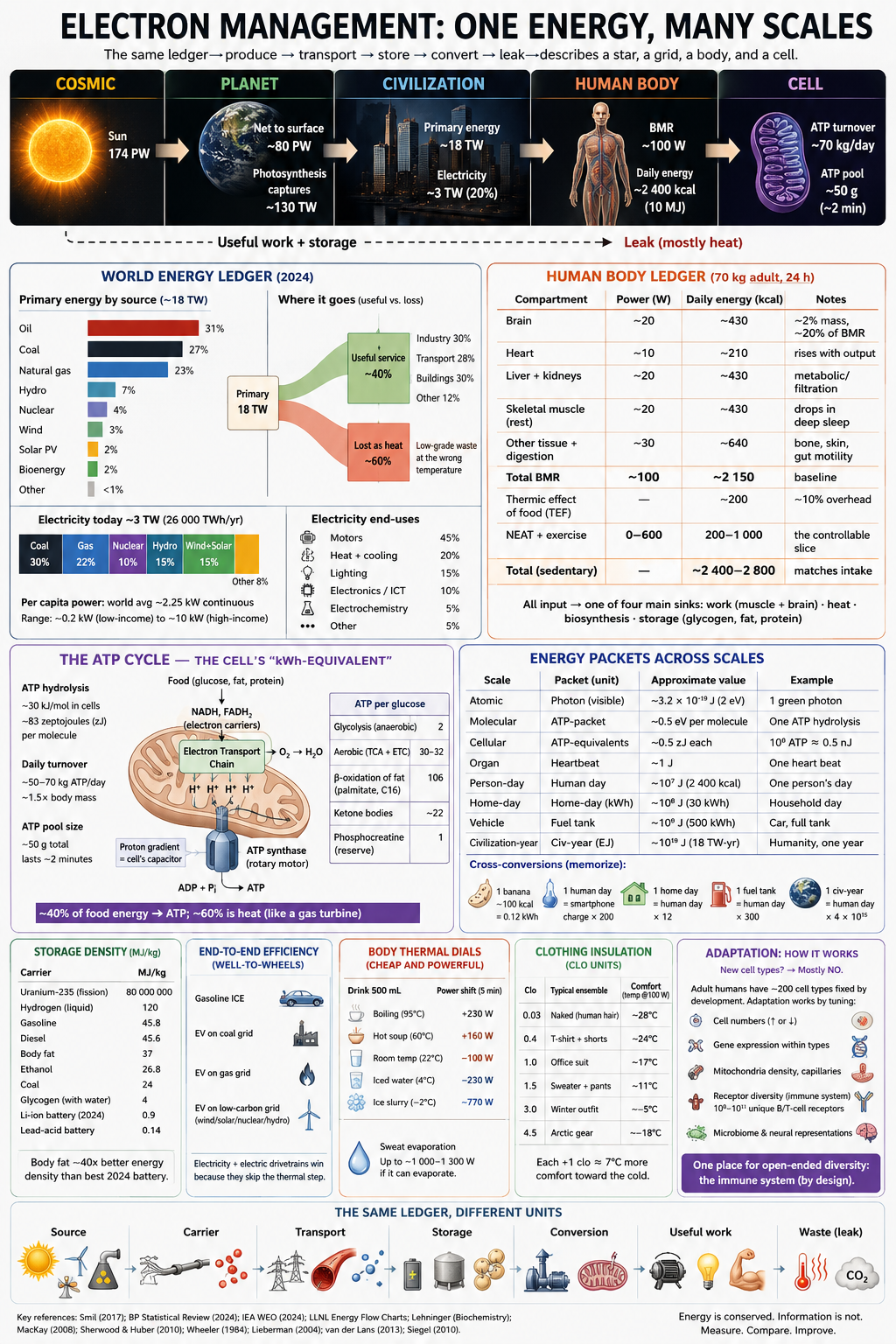
Status: budding | 2026-05-12 | rating: medium Compress levels: L0 ↓ L1 ↓ L2
The universe runs one currency — energy — printed by stars and burned by everything down to a neuron. Pick a compact unit, then the ledger reads cleanly.
L0 — TL;DR (≤5 lines)¶
Energy is the most fungible quantity in physics. At world scale, humans consume ~18 TW continuous (2024), 80 % from fossil hydrocarbons, ~20 % from electricity (3 TW), with the gap accounted for by direct combustion (transport, heat). At body scale, an adult runs at ~100 W (≈8.6 MJ/day, ~2000 kcal), cycles ~70 kg of ATP every day (each molecule turned over thousands of times), and routes essentially all input to one of four sinks: muscle work, neural work, heat, biosynthesis. The same accounting — produce · transport · store · convert · leak — describes a grid, a cell, and a civilization. The right compact unit isn't the electron — it is the packet: photon (sunlight), ATP (cell), kWh (grid), barrel-of-oil-equivalent (civilization).
L1 — Overview¶
Core question¶
What is the cleanest unit for talking about energy flow, and what does the same flow look like at three nested scales — civilization, human body, single cell? Where do the leaks dominate, and which interventions actually change them?
Why it matters¶
- Most everyday energy claims (food labels, "this saves 30 %", "renewables are X % of the grid") collapse without a shared unit.
- Body-scale and grid-scale share the same ledger structure (source → carrier → conversion → work + heat). Seeing them as one ledger ports intuitions both ways.
- The "electron" is a poor unit. It is a carrier of charge, not of energy. The energy lives in the field the electron moves through. A grid moves ~3 × 10²⁰ electrons per second but ~10¹⁸ J per second of energy — different things. The honest atomic-scale unit is the photon / phonon / chemical-bond quantum ("packet"), not the particle.
- Loss accounting is where the leverage is: ~60 % of input energy worldwide is lost as low-grade heat before doing useful work (LLNL flowchart, recurring). Cars are ~25 % efficient, coal plants ~35 %, gas turbines ~60 %. The remaining ~40 % is the actual delivered service.
Mermaid map (L1)¶
flowchart LR
  sun[sun] --> photo[photosynthesis] --> food[food]
  sun --> wind[wind] --> grid[grid]
  sun --> pv[PV cell] --> grid
  fossil[stored sun · coal/oil/gas] --> grid
  fossil --> heat[direct heat / transport]
  uranium[fission fuels] --> grid
  geo[geothermal · tides] --> grid
  food --> body[human body]
  body --> atp[ATP cycle]
  atp --> brain & muscle & heatb[heat]
  grid --> motor[motors] & light[light · ICT] & heatg[heat]
  brain -.-> waste[low-grade heat]
  muscle -.-> waste
  motor -.-> waste
Skeleton sub-claims¶
- A compact unit is required; choose by scale.
- Production has ~6 primary sources (sun, fossil sun, fission, fusion [not yet], geothermal, tidal).
- Transport always costs (line loss, ATP diffusion, blood flow).
- Storage is the hardest piece (batteries, glycogen, fat, water dams).
- Conversion costs follow Carnot at the thermal step; below Carnot in electrochemical and biological steps.
- Most loss is low-grade heat at the wrong temperature.
L2 — Deep dive¶
1. The compact unit problem¶
Energy units in active use:
| Unit | Domain | Conversion |
|---|---|---|
| Joule (J) | physics SI | 1 J = 1 N·m = 1 W·s |
| Calorie (cal) | chemistry, food (kcal) | 1 cal = 4.184 J; 1 kcal = 1 dietary "Calorie" = 4184 J |
| Watt-hour (Wh) | grid, batteries | 1 Wh = 3600 J; 1 kWh = 3.6 MJ |
| Electron-volt (eV) | atomic / nuclear | 1 eV = 1.602 × 10⁻¹⁹ J |
| BTU | HVAC, US heating | 1 BTU ≈ 1055 J |
| Barrel oil equivalent (boe) | energy economics | 1 boe ≈ 6.1 GJ ≈ 1.7 MWh |
| Tonne oil equivalent (toe) | global statistics | 1 toe ≈ 42 GJ ≈ 11.6 MWh |
| ATP hydrolysis | cell | ~30 kJ/mol ≈ 50 zJ per molecule under standard conditions; ~57 kJ/mol in cell |
| Photon (visible, 555 nm) | light | ≈ 3.6 × 10⁻¹⁹ J ≈ 2.25 eV |
The right compact unit by scale:
| Scale | Use this | Why |
|---|---|---|
| Civilization-year | TW continuous, EJ/year, toe | makes "world primary energy ≈ 18 TW" memorable |
| Grid second | GW, kWh | matches utility billing and meter logic |
| Building, home | kWh/month, kcal | matches the bill |
| Human day | kcal/day, MJ/day | matches food labels |
| Human minute | watts (W) | matches BMR (~100 W) and exercise (~400 W) |
| Cell-second | mol ATP / sec | matches enzyme kinetics |
| Single bond | eV, kJ/mol | matches reaction tables |
Conversion sanity checks worth memorizing:
- 100 W person × 24 h = 2400 Wh = 2064 kcal ≈ daily intake
- 1 banana ≈ 100 kcal ≈ 420 kJ ≈ 0.12 kWh ≈ a 100 W bulb for 1 h
- 1 gallon gasoline ≈ 33 kWh ≈ 28 000 kcal ≈ 14 days of food energy
- 1 L gasoline ≈ 8.7 kWh
- 1 kg battery (Li-ion 2024) ≈ 0.25 kWh — about 4 × lower than gasoline per kg, before accounting for engine vs. motor efficiency
- 1 m² midday sun ≈ 1 kW peak ≈ 200 W average annual at temperate latitudes
- Adult human at rest ≈ 100 W ≈ a single old incandescent bulb
2. World-scale ledger¶
Global primary energy supply (IEA / BP Statistical Review 2024):
| Source | Share of primary | Notes |
|---|---|---|
| Oil | ~31 % | ~100 Mb/d; transport-dominated |
| Coal | ~27 % | electricity + industrial heat |
| Natural gas | ~23 % | electricity + heating + feedstock |
| Hydro | ~7 % | mature; new build limited by sites |
| Nuclear (fission) | ~4 % | ~430 reactors operating |
| Wind | ~3 % | doubling roughly every 4 years |
| Solar PV | ~2 % | doubling roughly every 2–3 years |
| Bioenergy | ~2 % | traditional (cooking) + biofuels |
| Other (geothermal, tidal, etc.) | <1 % | niche but growing |
Continuous-power view:
- Total primary: ~18 TW (≈ 580 EJ/year)
- Of that, electricity: ~3 TW (~26 000 TWh/year)
- Of electricity: ~30 % from coal, ~22 % gas, ~10 % nuclear, ~15 % hydro, ~15 % wind + solar, rest biomass + oil
- Per capita (8 B people): ~2.25 kW continuous average; range ~0.2 kW (low-income) to ~10 kW (high-income, e.g. USA)
Where the global ~18 TW actually goes — useful service vs. loss:
| Service | Energy share (approx.) | Loss-as-heat share |
|---|---|---|
| Industry (steel, cement, chemicals, refining) | ~30 % | ~20 % is process heat that escapes |
| Transport (road, air, sea, rail) | ~28 % | ~75 % lost as heat (ICE engine) |
| Buildings (heating, cooling, lighting, appliances) | ~30 % | ~30 % through poor insulation / inefficient HVAC |
| Other (agriculture, fishing, non-energy chemical) | ~12 % | varies |
Aggregate: roughly two-thirds of primary energy is lost before performing useful work. The largest single recoverable inefficiency is internal-combustion engines in transport.
Sectoral electricity end-uses (global mix):
| End-use | Share of electricity |
|---|---|
| Motors (industrial + appliance) | ~45 % |
| Heating + cooling | ~20 % |
| Lighting | ~15 % |
| Electronics / ICT | ~10 % |
| Electrochemistry, electrolysis | ~5 % |
| Other (signaling, control) | ~5 % |
ICT (data centers + networks + devices) is ~2 % of global electricity but the fastest-growing slice, on the order of 6–10 %/yr.
3. Body-scale ledger¶
A 70 kg adult, sedentary, 24 h:
| Compartment | Power | Daily energy | Notes |
|---|---|---|---|
| Brain | ~20 W | ~430 kcal | near-constant; ~2 % mass, ~20 % BMR |
| Heart | ~10 W | ~210 kcal | rises with output |
| Liver + kidneys | ~20 W | ~430 kcal | metabolic / filtration baseline |
| Skeletal muscle (rest) | ~20 W | ~430 kcal | drops in deep sleep |
| Other tissue + digestion | ~30 W | ~640 kcal | bone, skin, gut motility |
| Total BMR | ~100 W | ~2150 kcal | varies ±15 % with age/sex/mass |
| Thermic effect of food (TEF) | adds ~10 % | ~200 kcal | digestion overhead |
| NEAT + exercise | 0–600 W brief peaks | 200–1000 kcal | the controllable slice |
| Daily total (sedentary) | ~2400–2800 kcal | matches the food label budget |
4. The ATP cycle — the body's "kWh-equivalent"¶
ATP (adenosine triphosphate) is the cell's universal energy packet. The numbers worth carrying:
- Energy per molecule: hydrolysis ATP → ADP + Pᵢ releases ~30 kJ/mol under standard conditions, ~50–60 kJ/mol in cellular conditions. Per molecule: ~83 zJ (zeptojoules; 10⁻²¹ J).
- Daily turnover: an adult cycles ~50–70 kg of ATP per day — more than body mass — by recycling the same ~50 g pool roughly 1500 times.
- Pool size: instantaneous ATP in body ~50 g; this would last only ~2 minutes without regeneration.
- Production pathways:
| Pathway | ATP per glucose | Speed | Substrate |
|---|---|---|---|
| Glycolysis (anaerobic) | 2 net | seconds | glucose only |
| Pyruvate → acetyl-CoA → TCA → ETC (aerobic) | ~30–32 | minutes | glucose, fat, protein |
| β-oxidation of fat | 106 per palmitate (C16) | hours | fatty acids |
| Ketogenesis (fasting / keto) | ~22 per ketone body | hours | derived from fat |
| Phosphocreatine reserve | 1 (re-phosphorylates ATP) | sub-second | local muscle reserve |
- Electron flow detail: glucose oxidation strips electrons via NAD⁺ → NADH and FAD → FADH₂. These carry the electrons to the inner mitochondrial membrane, where Complexes I–IV in the electron transport chain pass them downhill onto O₂ (final acceptor → water). The energy released pumps protons across the membrane, building a gradient. ATP synthase (Complex V) is a rotary motor that uses the proton flow to phosphorylate ADP to ATP. About 3 ATP per NADH, 2 per FADH₂.
- Efficiency: ~40 % of bond energy ends up in ATP, the rest is heat. About the same as a gas turbine — biology runs near the thermodynamic ceiling for a chemical engine at body temperature.
This is the actual "electron management" in a human body: electrons are stripped from food carbon, ferried by NADH/FADH₂ to the mitochondrial inner membrane, walked down the ETC, deposited on oxygen. The proton gradient is the cellular equivalent of a charged capacitor; ATP synthase is the cellular equivalent of an electric motor.
5. Compact representation — the "packet" framing¶
Rather than tracking electrons, track energy packets sized to the scale:
| Scale | Packet | Approximate value |
|---|---|---|
| Photon, visible | photon | 2 eV ≈ 3.2 × 10⁻¹⁹ J |
| Chemical bond, typical | bond | 200–800 kJ/mol ≈ 2–8 eV |
| ATP hydrolysis | ATP-packet | 0.5 eV / molecule ≈ 30 kJ/mol |
| Neuron action potential | spike | ~10⁹ ATP-equivalents (~0.5 nJ) |
| Heart-beat | beat | ~1 J mechanical work |
| Breath cycle | breath | ~0.5 J work, 1.3 kcal/min metabolic |
| Adult, one day | day | ~2400 kcal ≈ 10 MJ |
| Household, one day | home-day | ~30 kWh ≈ 100 MJ (rich-world) |
| Car, one full tank | tank | ~500 kWh ≈ 1800 MJ |
| Smartphone charge | charge | ~15 Wh ≈ 50 kJ |
| Laptop charge | charge | ~50 Wh ≈ 180 kJ |
| Civilization, one year | civ-year | ~580 EJ ≈ 18 TW |
Sense-making cross-conversions:
- A day of one human ≈ a charge of one smartphone × 200
- A home-day ≈ a human-day × 12
- A tank ≈ a human-month
- A civ-year ≈ day of one human × 4 × 10¹⁵ (i.e. 4 quadrillion human-days — about 500 000 years of one person's energy)
6. Storage — the hardest piece at every scale¶
Energy density by carrier (ranked highest → lowest):
| Carrier | MJ/kg | MJ/L | Notes |
|---|---|---|---|
| Uranium-235 (fission) | ~80 000 000 | — | atomic; impractical at small scale |
| Hydrogen (gas) | 120 | 0.01 (1 bar) | high mass density, terrible volumetric |
| Hydrogen (liquid, 20 K) | 120 | 8.5 | cryogenic complexity |
| Diesel | 45.6 | 38.6 | the benchmark transport fuel |
| Gasoline | 45.8 | 34.2 | slightly less dense than diesel |
| Jet A | 43.0 | 35.0 | optimized for aviation |
| Natural gas (CNG) | 53 | 9.0 | needs ~200 bar tanks |
| Ethanol | 26.8 | 21.1 | ~2/3 of gasoline by volume |
| Coal | 24 | 30 | varies by grade |
| Body fat | 37 | 35 | the body's deep reserve |
| Glycogen (with water) | 4 | 6 | the body's fast reserve |
| Wood (dry) | 16 | 10 | classical fuel |
| Li-ion battery, 2024 | 0.9 | 2.5 | improving ~5–8 %/year |
| Lead-acid battery | 0.14 | 0.4 | mature; cheap |
| Flywheel | 0.5 | — | high power, low energy |
| Pumped hydro | 0.001 per m head | — | the only grid-scale today |
Body fat is ~40× more energy-dense than the best 2024 battery. That gap explains why animals store fat instead of "biological batteries" — and why aviation cannot easily electrify.
Glycogen vs fat tradeoff in the body:
- Glycogen: ~500 g total (300 in muscle, 100 in liver) ≈ 2000 kcal. Pulls in ~3 g water per g of glycogen, so the wet energy density is poor.
- Fat: 10–20 kg typical reserve ≈ 90 000–180 000 kcal.
- Glycogen is the fast battery (anaerobic + acute brain glucose); fat is the deep reservoir (aerobic + long-fast); protein is structural but can be sacrificed in extreme deficit.
This mirrors a hybrid car: small fast battery (glycogen / Li-ion) for peak demand, big slow tank (fat / gasoline) for range.
7. Transport and conversion losses¶
Every step from source to delivered service costs.
Grid losses (typical wealthy country):
| Step | Loss |
|---|---|
| Coal plant (thermal → electrical) | 60–65 % (only 35 % out) |
| Modern gas combined cycle | 35–40 % loss (60 % out) |
| PV cell, silicon | 78–80 % of incident sun lost (20–22 % out) |
| Transmission (high voltage) | 2–5 % |
| Distribution (medium / low voltage) | 3–8 % |
| Step-down transformers | 1–3 % |
| End-use motor / appliance | varies 10–50 % |
End-to-end electric vehicle vs. internal-combustion (well-to-wheels):
- Gasoline ICE: ~16–20 % well-to-wheels.
- EV on coal grid: ~26 % well-to-wheels.
- EV on gas grid: ~35 %.
- EV on solar/wind/nuclear/hydro grid: ~70 % (loss only in conversion + battery + motor; no thermal step).
Body losses:
- Mitochondrial efficiency (chemical → ATP): ~40 %.
- ATP → muscle contraction: ~25 % (so ~10 % overall food → mechanical work).
- Brain: nominally 100 % "useful" by definition — but ~70 % of brain energy is baseline / housekeeping, not new computation.
8. Source — production at planetary scale¶
The sun delivers ~174 PW (1.74 × 10¹⁷ W) to Earth's top of atmosphere. Of that:
- ~30 % reflected (clouds, ice, surface)
- ~23 % absorbed in atmosphere → weather
- ~47 % absorbed at surface
So ~80 PW reaches the surface. Photosynthesis captures ~130 TW of it as chemical energy (NPP — net primary production). Human civilization runs at ~18 TW, of which ~3 TW is electricity.
Civilization is currently using ~0.01 % of incoming solar. The room for renewable expansion is not physical, it is the transport and storage problem.
Fossil hydrocarbons are stored sunlight from the Carboniferous (~300 Myr ago) — a buried capacitor charged over hundreds of millions of years, being discharged in a few centuries.
Fission fuels (U, Th) are remnants of supernovae. There are no modern processes that produce them. The terrestrial reserve at current burn rate is ~80–200 years (uranium) or ~10 000 years (thorium + breeders).
Fusion (sun-style) is the only physically-known route to multi-million-year stable supply on Earth. ITER first plasma 2025, commercial fusion: speculative timeline.
9. Same-shape ledgers across scales¶
The structural isomorphism worth noting:
| Step | Cell | Body | Grid | Civilization |
|---|---|---|---|---|
| Source | sun → glucose via plants | food | coal / gas / sun / wind | sun (current + stored) |
| Carrier | NADH, FADH₂, ATP | blood glucose, fatty acids | electricity, gas pipes | oil tankers, wires, pipelines |
| Transport | diffusion, blood flow | circulatory + lymphatic | transmission lines | shipping, pipelines |
| Storage | small ATP pool + creatine | glycogen + fat | pumped hydro, batteries | strategic reserves, fuel inventories |
| Conversion | mitochondrial ETC | muscle, brain | motors, lights | engines, heaters |
| Useful work | ion gradients, biosynthesis | movement, cognition | mechanical, light, info | transport, comfort, GDP |
| Waste | heat, CO₂, H₂O | heat, CO₂, urea | heat, CO₂, materials | heat, CO₂, pollutants |
The same ledger; different units.
10. Leverage points — where intervention pays¶
| Scale | Highest-leverage intervention | Why |
|---|---|---|
| Body | sleep + protein + walking | recovers brain efficiency, builds muscle (largest BMR slice), uses NEAT (biggest variable) |
| Home | insulation, heat pump, LED lighting | ~50–70 % drop in residential energy without behavior change |
| Transport | reduce ICE driving (walk/bike/transit/EV), fly less | ICE is the worst-efficiency major energy use |
| Grid | scale low-carbon firm (nuclear, hydro) + variable (wind, solar) + storage | the carbon and conversion-loss problems are coupled |
| Civilization | electrify everything, decarbonize the electricity | most efficiency gains follow from converting thermal end-uses to electric |
11. "Why not just measure electrons?"¶
The user's question is precise: can we represent the world's energy flow in some compact unit, maybe electrons but maybe something better?
Electrons are the wrong unit for three reasons:
- The electron itself carries almost no energy. A single electron in a household wire carries ~10⁻¹⁹ J. The same electron, moved through 1 V, carries 1 eV. Through 100 000 V (transmission), 100 keV. The energy is field × charge × distance, not a property of the electron alone.
- Many energy carriers are not electrons. Photons (sunlight), phonons (heat), chemical bonds, gravitational potential, nuclear binding. A unit pegged to electrons would have to convert all of these anyway.
- Granularity mismatch. A breath is ~3 × 10²² ATP-equivalents. A grid second moves ~10²⁰ electrons through ~10⁵ V. Neither number lives at human scale.
The compact representation that does work is the scale-matched packet: photon at atomic, ATP at cellular, breath at organism-minute, kWh at home-day, EJ or TW at civilization-year. The same energy moves through all of them; the unit just resizes.
Visual analogue:
flowchart LR
  joule[Joule · universal] --> packets[packets · scaled]
  packets --> photon[photon · ~10⁻¹⁹ J]
  packets --> atp[ATP · ~10⁻¹⁹ J]
  packets --> beat[heart beat · ~1 J]
  packets --> day[human day · ~10⁷ J]
  packets --> home[home day · ~10⁸ J]
  packets --> tank[fuel tank · ~10⁹ J]
  packets --> civ[civilization year · ~10¹⁹ J]
12. Body-scale thermal load shifters — the cheap dials¶
The body's thermal budget is dominated by the BMR (~100 W) and the loss channels (radiation, evaporation, convection, conduction — see BODY-AS-ENGINE §1). At ambient ~20 °C clothed, a still adult is in balance. Below that, the body must generate more heat or block more loss. Several cheap dials shift the ledger by 10–100 W.
Hot vs cold food and drink¶
Specific heat of water = 4.18 J/(g·K). Body temp = 37 °C. Take a 500 mL drink:
| Drink temp | ΔT to body | Energy to body to equalize | Power for 5 min |
|---|---|---|---|
| Boiling tea, 95 °C | warms by 58 °C above body? — body loses to evaporative-cooling and conduction to environment from the cup; ingested liquid at 60 °C reaches stomach near 50 °C | the body must absorb ~70 kJ (≈17 kcal) of heat from the hot drink to bring 500 g from 50 → 37 °C | +230 W warmth gain (briefly) |
| Hot soup, 60 °C | +23 °C above body | ~48 kJ (~11 kcal) net warming | +160 W |
| Room temp, 22 °C | −15 °C below body | body spends ~31 kJ (~7.5 kcal) to warm it up | −100 W brief cooling |
| Iced water, 4 °C | −33 °C below body | ~69 kJ (~16.5 kcal) to warm | −230 W brief cooling |
| Ice slurry, −2 °C (with latent heat of fusion!) | −39 °C plus phase change | 500 g ice → water absorbs an extra 167 kJ from the body (latent heat 334 J/g × half ice fraction) → total ~230 kJ ≈ 55 kcal | −770 W during melt-and-warm |
Practical consequences:
- Ice slurry pre-cooling is a real ergogenic intervention for endurance athletes in heat (Siegel 2010, Stevens 2017): ~7 g/kg ice-slurry pre-load lowers core temperature 0.2–0.5 °C and extends time-to-exhaustion by 10–17 %.
- "Negative calorie" via cold water is mostly myth — 500 mL of 4 °C water burns ~17 kcal to warm. Drinking 3 L/day of iced water ≈ 100 kcal/day, real but small.
- Hot drinks in heat (paradox): hot tea in a hot environment triggers sweating, and if the sweat can evaporate, net cooling exceeds the heat absorbed (Bain 2012, Acta Physiologica). In humid heat (where sweat can't evaporate) hot drinks are warming on net.
- Stomach can hold ~50 °C briefly without damage; oral mucosa scalds at ~60 °C; arterial blood quickly redistributes the heat, so the drink's energetic effect is gentle, distributed, and short (~5 min half-life as the bolus dilutes into the ~5 L blood volume + ~40 L total body water).
The big takeaway: drink temperature shifts ±100–700 W briefly. A pot of soup in winter is a real heating contribution beyond its calories.
Clothing — insulation, R-values, the clo¶
The clothing industry uses the clo unit:
- 1 clo = insulation needed to keep a sedentary person comfortable at 21 °C, 50 % humidity, still air = thermal resistance of 0.155 m²·K/W.
- A typical office suit ≈ 1.0 clo. Heavy winter outfit ≈ 3–4 clo. Polar exploration gear ≈ 4–5 clo. Underwear-only ≈ 0.04 clo.
Heat loss through clothed body:
For a 1.8 m² adult, skin 34 °C, calm air, R_air ≈ 0.07 m²·K/W:
| Clothing | R_clothing | T_air at thermal balance (BMR ~100 W) |
|---|---|---|
| Naked | 0 | ~28 °C |
| Light (T-shirt + shorts), 0.4 clo | 0.062 | ~24 °C |
| Office suit, 1.0 clo | 0.155 | ~17 °C |
| Sweater + pants, 1.5 clo | 0.23 | ~11 °C |
| Winter outfit, 3.0 clo | 0.47 | ~−5 °C |
| Arctic gear, 4.5 clo | 0.70 | ~−18 °C |
Each clo unit roughly extends comfortable temperature ~7 °C downward. Layering wins because each layer adds R-value with trapped air between, and you can shed layers as exertion rises. Wind cancels most of the air-side R: at 30 km/h, the R_air falls to ~0.02 — outerwear needs windproof shell to keep clo-rating honest.
Failure modes worth naming:
- Cotton in cold-wet = killer. Cotton holds water (1 g per g fiber), water has 24× the thermal conductivity of dry air. Wet cotton ≈ 0.1 clo when designed for 1.0. Wool stays warm when wet because the fiber's crimp preserves air pockets; synthetics shed water. "Cotton kills" is mountaineering 101.
- Overdressing in exertion spikes sweat, soaks insulation, then the dressed person cools faster on the rest break than an underdressed one. Be slightly cold while moving.
- Underdressing extremities — fingers, toes, ears, nose — is the common cold-injury vector; central core stays fine while peripheries lose function below ~10 °C skin temp (frostnip threshold).
Hair — and the human anomaly of being mostly hairless¶
Mammals are typically furred at 50–100 hairs/mm². Humans have hairs almost everywhere at low density and long terminal hair on scalp, axillae, pubis, and (males) face/chest — but the body is functionally naked for insulation purposes.
| Coat type | Effective R | Notes |
|---|---|---|
| Polar bear fur | ~0.6 m²·K/W (~4 clo) | dense + hollow-shaft hair; transparent guard hairs let UV reach the black skin |
| Wolf winter coat | ~0.35 (~2.3 clo) | seasonal double coat |
| Domestic cat | ~0.15 (~1 clo) | piloerection adds ~15 % |
| Human body hair | ~0.005 (~0.03 clo) | piloerection useless — too sparse to trap air; goosebumps are a vestigial reflex |
| Human scalp hair | ~0.05 if thick (~0.3 clo) | does shed heat in summer (provides shade) more than retain it |
Why humans lost fur — leading hypotheses, mostly complementary:
- Endurance-running thermoregulation (Wheeler 1984; Lieberman 2004). Bare skin + 2–5 M sweat glands enables evaporative cooling at ~600 W in dry heat. A furred animal at the same metabolic rate would overheat in minutes. Humans uniquely pursue prey to thermal exhaustion (persistence hunting). Fur was the trade-off.
- Parasite reduction (Pagel & Bodmer 2003) — body lice + fleas thrive in fur. Hairlessness reduces ectoparasite load; sexual selection for visibly clean skin reinforces.
- Aquatic phase / wading (the aquatic ape hypothesis, Hardy 1960) — popular, mostly rejected; sparse fur is consistent with semi-aquatic mammals but the rest of human anatomy is not adapted to water.
What hair is still doing in humans:
- Scalp: ~120 000 hairs, primarily UV shielding for the brain (the highest metabolic-rate organ + a high-elevation target for sun); secondarily sexual signal.
- Axillary + pubic: dispersing apolipoprotein-bearing apocrine sweat → wider scent radius (pheromonal signaling, weak in humans).
- Eyelashes + eyebrows: particle deflection + sweat redirection from forehead away from the eyes (anyone who has shaved an eyebrow learns this).
- Nasal + ear: filtration of inhaled particulates, prevention of insect intrusion.
- Vellus body hair: residual tactile sensitivity (each follicle innervates 1–6 mechanoreceptors); minimal thermal contribution.
Bald vs hirsute scalp thermally:
- Bald scalp loses ~50 % more radiative + convective heat than haired scalp in cold (Vahdat 2018, J. Phys. Therapy Sci.).
- In hot sun, bald scalp gains ~30 % more solar radiation — hence the global cultural convergence on hats / turbans / kufi in equatorial regions.
- Hat thermal performance ~0.2 clo equivalent over the scalp — meaningful in the cold even if cliché ("most heat lost through the head" is folklore: real share is ~10 % of total loss, proportional to head's ~10 % of body surface area).
Sweat — the high-power evaporative channel¶
- Latent heat of vaporization of water at body temp = 2426 J/g.
- Max sustainable sweat rate: 1.5–2 L/h (acclimatized adult) = ~1000–1300 W of evaporative cooling — if it can evaporate.
- Sweat that drips is wasted (no phase change, no cooling). Wet-bulb temperature above ~35 °C makes sweat evaporation impossible; ~6 hours at wet-bulb 35 °C is lethal for a healthy young adult (Sherwood & Huber 2010).
- Acclimatization to heat over 10–14 days: sweat starts earlier (lower threshold), produces more dilute sweat (less Na loss), expands plasma volume → higher cardiac stroke volume at lower HR.
Brown adipose tissue (BAT)¶
A second, non-shivering thermogenic channel:
- Brown fat is dense with mitochondria expressing UCP1 (uncoupling protein 1), which short-circuits the proton gradient → ATP synthesis bypassed → energy released as direct heat.
- Adult humans have ~50–100 g BAT (mostly supraclavicular and paravertebral). Infants have much more (~5 % of body mass).
- Recruited by 4–6 weeks of cold exposure (cold showers, 14–17 °C ambient sleep) → +100–300 kcal/day baseline thermogenesis once established (van der Lans 2013).
- Pharmacologically activated by β3-adrenergic agonists (mirabegron); active research target for metabolic disease.
Behavioral combinations¶
Bringing the dials together:
| State | Body adjustments | Behavioral adjustments | Net effect |
|---|---|---|---|
| Cold + still + dressed | piloerection (vestigial), peripheral vasoconstriction, shivering 4–5× BMR | hot drink, blanket layers, sun exposure | hold core; net +200–500 W |
| Cold + active | sympathetic ↑, fatty-acid mobilization, BAT recruit (chronic) | shed layers as core rises, hands in armpits, mouth shut + nasal breathe | balance; -10–-15 °C tolerated for hours |
| Heat + still | vasodilation, sweating, lower BMR slightly | shade, fan, cold drink, wet skin, loose light cotton | dissipate; up to ~1000 W if dry |
| Heat + active | massive sweat, plasma volume up, heart redirects to skin | sip electrolytes, pre-cool with ice slurry, intermittent shade | extend window; survive 38 °C dry to ~4 h |
| Fever (induced) | hypothalamus raises set-point 1–4 °C, shivering produces +50–200 W | rest, fluids, antipyretics if needed | fight infection (most pathogens replicate poorly at +2 °C) |
13. Adaptation — and the cell-differentiation question¶
The user's deep question: when the body adapts (training, acclimatization, dietary shift, altitude), does it generate new cell types (more diversity) — or does it tune the existing types more sharply? The honest answer is mostly the latter, with one important exception.
Cell-type repertoire is fixed in adults¶
- An adult human has ~200 distinguishable differentiated cell types (classical histology count). Modern single-cell RNA-seq resolves ~400–500 transcriptional states within those, but most are tissue-context variants of the same lineage.
- That repertoire is fully established by mid-fetal development. No major new cell type arises in adult life under any normal condition.
- The exceptions are limited and well-defined:
- Hematopoietic stem cells continuously generate ~10 blood cell lineages (red cells, granulocytes, lymphocytes, platelets, etc.) — but from a fixed lineage tree.
- Adaptive immunity: B and T cells undergo somatic recombination of their receptor loci, producing ~10⁸ – 10¹¹ unique receptor specificities per individual. This is the one place the body generates effectively unbounded diversity — not new cell types, but a vast diversity of cells of one type. (See L1 for why this is the exceptional case.)
- Adult neurogenesis (hippocampal dentate gyrus, olfactory bulb): low rate, neurons of an existing type.
- Reactive astrocytes, myofibroblasts (wound healing) — transient state changes, not new lineages.
Adaptation operates at four timescales¶
| Timescale | Mechanism | Example | Reversibility |
|---|---|---|---|
| Seconds–minutes | enzyme phosphorylation, ion channel gating, vasomotor tone | breath-hold response, fight-or-flight, glucose uptake spike | full |
| Minutes–hours | gene expression change, mRNA + protein turnover | acute stress proteins, glycogen depletion | full |
| Days–weeks | cellular remodeling — more mitochondria, more capillaries, more contractile proteins per existing cell | aerobic training (mitochondrial biogenesis), altitude acclimatization (more red cells via EPO), heat acclimatization (sweat gland sensitivity) | reversible over weeks |
| Months–years | tissue-level remodeling — more muscle fibers (hyperplasia, modest in humans), bone remodeling, vascular structure | sustained training, dietary effect on adipose mass, occupational adaptations (rower vertebrae, pianist motor cortex) | partial; some persists |
| Decades / development | cell-type establishment via differentiation cascades from stem cells | growth, puberty, menopause | no |
So when an adult "adapts to cold over 4 weeks" or "adapts to altitude over 3 weeks" — they are doing the third row: existing cells (BAT adipocytes, erythrocytes, sweat gland cells) expand in number and/or shift gene expression. They do not become a new cell type.
Does adaptation become more diverse over time?¶
A precise version of the user's question. The answer depends on what we measure:
| Diversity metric | Increases with adaptation? | Note |
|---|---|---|
| Number of cell types | No | fixed ~200 by birth |
| Number of cells | Modestly | hyperplasia limited in adults; mostly hypertrophy |
| Cells per existing type, where useful | Yes | RBC at altitude (+30 %), mitochondria density in trained muscle (+50–100 %), capillary density in trained muscle (+30 %), brown fat mass with chronic cold (+50–300 %) |
| Gene-expression diversity within existing types | Yes | cell-state heterogeneity rises with environmental complexity (Pijuan-Sala 2019) |
| Receptor diversity (B / T cell) | Yes, dramatically | each new pathogen exposure expands clone count of matching specificity 10⁴–10⁶× |
| Microbiome diversity | Yes, with varied diet | fiber + fermented food intake → Shannon diversity of gut bacteria rises ~30 % in months |
| Neural representational diversity | Yes | new motor / cognitive skills carve cortical territory; expert brains show measurably finer feature representations (London cabbies' hippocampus, Maguire 2000) |
So the body's adaptation strategy is:
- Fix the cell-type vocabulary early. (Costly evolutionarily, but the lineage tree is set during embryogenesis.)
- Expand or contract cell numbers within the vocabulary in response to load. Useful types proliferate, unused types atrophy.
- Tune gene expression within each existing cell — the cells themselves become more specialized to their workload.
- Generate molecular-level diversity where the environment is unbounded (antibodies, T-cell receptors, microbiome, gut mucus glycans). This is the one place the body bet on open-ended diversity as a strategy.
Compare that to evolution at species level: there, new types do arise — but on millions-of-years timescales. The body's strategy is to push the diversification to the molecular-receptor level (immune system) where the generator can be biochemical (RAG recombinase, somatic hypermutation), not anatomic.
Why this design¶
Two engineering-style reasons make the "fix the types, tune the counts and expressions" choice obvious in retrospect:
- Cost of differentiation: building a new cell type from scratch requires a multi-stage transcriptional cascade and a surrounding tissue niche. Doing that during adult life would require disrupting working tissue. Evolution's answer: do the differentiation once, then keep the niches stable.
- Robustness vs novelty trade-off: an adult organism's job is to stay alive long enough to reproduce. Novelty in cell types is high-risk (cancer is exactly: a cell type drift you didn't want). Robustness via load-tuning of existing types is low-risk and reversible.
The immune system is the deliberate exception: because the pathogen space is open-ended, the body delegated open-ended diversity to one cell lineage (lymphocytes) and gave it a biochemical generator. Everything else stays in the fixed catalog.
The lesson, restated for the swarm-godding context: diversity in adaptation is best concentrated in the substrate that is designed for it. The body chose immune receptors. The repo chose lessons + frontiers. The cells/files themselves stay type-stable; the combinations and expressions are where the adaptation happens.
Open questions¶
- Right "natural unit" for civilization-scale storage: kWh, GJ, toe, or a behavioral unit like "household-years"? Different audiences require different anchoring.
- Will Li-ion plateau?: 2024 cell-level density ≈ 290 Wh/kg. Theoretical chemistry max ~500 Wh/kg for Li-ion; solid-state promised ~400 Wh/kg in production. Past that we need new chemistries (Li-S, Li-air, ?).
- Will fusion arrive in time: ITER 2035 first DT; commercial fusion 2050+ optimistic. Climate / energy transition timelines don't depend on it.
- Biological hard ceiling on ATP turnover: hummingbird flight muscle hits ~10× human peak per-gram rate. Why don't large animals approach this? Almost certainly heat dissipation.
- Per-bit ICT energy floor: Landauer limit (kT ln 2 per bit erased) ≈ 3 × 10⁻²¹ J at 300 K. Modern transistors are ~10⁻¹⁵ J per bit operation — 6 orders of magnitude above. Quantum and reversible computing pushes the floor down, but not toward zero.
- Why ~200 cell types and not 50 or 2000: comparative-anatomy data clusters most large vertebrates near this number. Is the ceiling a developmental-program complexity limit or a tissue- niche packing limit?
- Hyperplasia in human muscle: longstanding debate whether resistance training can add new muscle fibers (vs only hypertrophy of existing). Animal work (cat tenotomy, McCall 1996) shows fiber-splitting; human evidence remains contested.
- Limits of cold acclimatization without BAT pharmacology: what is the achievable BAT mass from natural exposure alone in an adult? Studies cap around ~200 g; not enough to be a primary thermogenic strategy.
References¶
- Smil, V. (2017). Energy and Civilization: A History. — the reference for civilization-scale energy.
- BP / Energy Institute Statistical Review of World Energy (annual).
- IEA World Energy Outlook (annual).
- Lawrence Livermore National Laboratory: U.S. Energy Flow Charts (Sankey diagrams that show useful vs. lost energy by sector).
- Lehninger, Principles of Biochemistry — ATP cycle, ETC.
- Roach, J. R. et al. (2007). ATP turnover in human red blood cells. — daily ATP cycling numbers.
- Mac Kay, D. J. C. (2008). Sustainable Energy — Without the Hot Air. — the gold standard popular treatment of energy at individual and national scale.
- Murray, C. K. Energy in Nature and Society (2008).
- Lovelock, J. (1979). Gaia. — Earth as energy/material flux system.
- Wheeler, P. E. (1984). The evolution of bipedality and loss of functional body hair in hominids. J. Human Evolution.
- Lieberman, D. E., & Bramble, D. M. (2004). The evolution of marathon running. Nature.
- Pagel, M., & Bodmer, W. (2003). A naked ape would have fewer parasites. Proc R Soc B.
- Sherwood, S. C., & Huber, M. (2010). An adaptability limit to climate change due to heat stress. PNAS.
- Siegel, R., et al. (2010). Ice slurry ingestion increases core temperature capacity and running time in the heat. Med Sci Sports Exerc.
- Bain, A. R., et al. (2012). Body heat storage during physical activity is lower with hot fluid consumption under conditions that permit full evaporation. Acta Physiologica.
- van der Lans, A. A. J. J., et al. (2013). Cold acclimation recruits human brown fat and increases nonshivering thermogenesis. J. Clinical Investigation.
- Maguire, E. A., et al. (2000). Navigation-related structural change in the hippocampi of taxi drivers. PNAS.
- ASHRAE Handbook — Fundamentals: clo and met units for HVAC comfort modeling.
- Lodish, H., et al. Molecular Cell Biology — cell-type catalog and differentiation cascades.
- Pijuan-Sala, B., et al. (2019). A single-cell molecular map of mouse gastrulation and early organogenesis. Nature.
Inspiration sources¶
- Vaclav Smil — empirical, low-rhetoric energy accounting.
- David MacKay — the watt-per-person-per-day framing.
- Robert Rapier (R-Squared Energy) — practical refining numbers.
- Hannah Ritchie / Our World in Data — clean visualisations of the same numbers.
- Peter Mitchell (chemiosmosis, Nobel 1978) — proton gradient as cellular kWh.
- Nick Lane (The Vital Question, 2015) — the deep evolutionary story of mitochondrial energy.
See also¶
FOOD-AS-FUEL— input side of the body ledger.BODY-AS-ENGINE— the engine the food drives.ENERGY-AND-ATTENTION— what the watts buy in cognition.HEALTH-AS-INFRASTRUCTURE— body energy as a substrate.UNIVERSE-EVOLUTION-AS-COMPRESSION— energy and information across scales.../godding/sustainability.md— long-horizon energy ledgers.../ISOMORPHISM-ATLAS.md— the same-shape-ledger argument formalized.