Mixtures
flowchart LR
  tastes[5 tastes · sweet · salty · sour · bitter · umami] --> mix1[interaction matrix]
  smells[10⁴ smells · ~10D embedding] --> mix2[combinatorial blend]
  mix1 --> flavor
  mix2 --> flavor
  flavor --> pairing[what goes with what]
pairing --> rules[shared-volatile rule · cuisine grammars · fat carries aroma]- Mixing as kernel — the formal seam — O-information signs synergy; non-Euclidean kernels; the abstract K(w,p)
- olfactory senses — the smell substrate
- food as fuel — what's actually on the plate
- body as engine — state shifts from taste/smell
Investigation · rating: medium. Heston Blumenthal / François Benzi's 'foodpairing hypothesis' (shared volatiles → good pairing) and Yong-Yeol Ahn's 2011 network analysis are the modern attempt to mathematize what perfumers and chefs have done by ear.
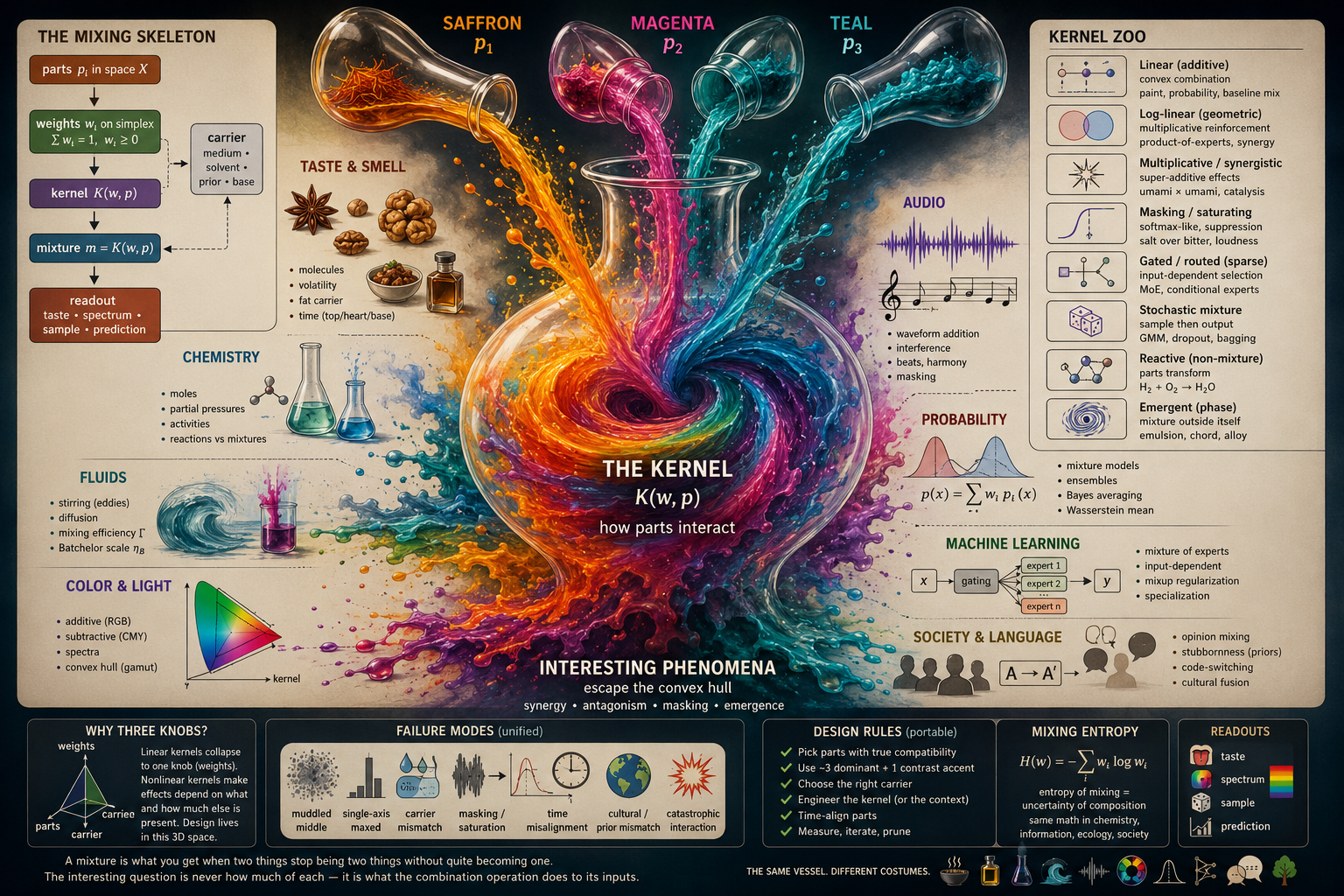
K(w,p) — describes how parts interact across taste, chemistry, color, sound, probability, and society.
Status: budding | 2026-05-12 | rating: medium Compress levels: L0 ↓ L1 ↓ L2
Two cheap parts can make something the price of neither. Sometimes the trick is overlap; sometimes it is contrast. Most "what goes with what" is the same question — taste, smell, color, sound — about how perceptual axes compose.
L0 — TL;DR (≤5 lines)
Tastes are five orthogonal axes (sweet, salty, sour, bitter, umami) plus fat-as-a-sixth and capsaicin/menthol/astringency as side-channel sensations. Their interactions are well-mapped: salt suppresses bitter and amplifies sweet; sweet softens sour and masks bitter; umami × umami goes super-additive (glutamate + inosinate / guanylate ≈ 8× single). Smells live in a much higher space (~400 receptors, ~10-D embedding) and combine by shared volatile molecules (the foodpairing hypothesis) and by perfumery's top/heart/base note structure that uses volatility to sort the bouquet in time. Smell is most likely shape-binding to receptors, not vibration; the receptor activation pattern itself compresses to ~10–20 dimensions, which is why a single chemist's word like "green" or "smoky" tags a whole cluster.
L1 — Overview
Core question
When two foods (or two smells, or two sounds) are mixed, when is the result good, when is it bad, and when is it something else entirely? Is there an underlying grammar, or is each cuisine an isolated tradition? And the user's deeper question: is smell a vibration function (Turin) or a shape-binding function (Buck & Axel), and either way — can we distill it to subcomponents small enough to engineer pairings deliberately?
Why it matters
- Food and perfume are the two domains where humans practice multi-dimensional sensory composition for thousands of years. What chefs and perfumers do is a working theory of perceptual algebra.
- Taste interactions are robust enough to teach as rules (salt-on-grapefruit reduces bitter; black coffee with sweet pastry is comfortable because sweet masks bitter). Mis-pairing costs little; learning costs less.
- Smell pairing is at the frontier — Ahn et al. 2011 mapped 56 000 recipes to 381 ingredient flavor-volatile profiles; Western cuisine pairs high-shared-volatile ingredients (foodpairing rule), Asian cuisine pairs low-shared-volatile (anti-pairing). Two strategies coexist.
- The mechanism question (shape vs vibration) maps to the feasibility question (can we design novel smells from first principles, or only from analogy?). Shape says yes; vibration says even more yes.
Mermaid map (L1)
flowchart LR
  ingredients --> volatiles[volatile profile · ~50–200 molecules each]
  ingredients --> tastes[taste profile · 5 axes + fat + side channels]
  volatiles --> overlap[shared-volatile graph]
  volatiles --> notes[top · heart · base · by volatility]
  tastes --> matrix[interaction matrix · suppress · amplify · synergize]
  overlap --> pair_west[western: high overlap pairs well]
  overlap --> pair_east[east-asian: low overlap pairs well]
  matrix --> chef[chef rules: salt grapefruit · sugar coffee · acid butter]
  notes --> perfume[top citrus · heart floral · base musk/wood]
  pair_west --> good[the dish works]
  pair_east --> good
  chef --> good
  perfume --> good
Skeleton sub-claims
- Five tastes have a small, well-charted interaction matrix.
- Umami synergy is real and large.
- Fat is the universal aroma carrier and slow-release substrate.
- Volatility sorts a bouquet in time (top → heart → base).
- "Foodpairing" by shared volatiles is one strategy, not a law.
- Asian-vs-Western cuisines are an empirical anti-correlation in pairing strategy.
- Smell perception is dominantly shape-binding; vibration is unresolved.
- Both receptor and perceptual spaces compress to ~10–20 dimensions.
L2 — Deep dive
1. The five tastes (and the side channels)
The five tongue tastes — receptors and signal:
| Taste | Receptor type | Senses | Detection threshold |
|---|---|---|---|
| Sweet | T1R2 + T1R3 GPCR heterodimer | sugars, sweeteners, some peptides | sucrose ~10 mM |
| Salty | ENaC channel (and others for high-Na bitterness) | Na⁺ specifically | NaCl ~10 mM |
| Sour | OTOP1 channel | H⁺ (acidity) | citric acid ~1 mM |
| Bitter | T2R GPCR family (~25 types) | alkaloids, many plant toxins | quinine ~10 µM (caffeine ~1 mM) |
| Umami | T1R1 + T1R3 GPCR heterodimer | L-glutamate, L-aspartate; potentiated by 5′-IMP / 5′-GMP | MSG ~1 mM |
Side channels (not classical tastes; transduced separately):
| Sensation | Substrate | Notes |
|---|---|---|
| Fat | CD36, GPR120, free fatty acids; also texture | proposed 6th taste; mucosal AND oral |
| Pungency / heat | TRPV1 (heat-activated channel) | capsaicin, piperine; same channel as actual heat |
| Cool / mint | TRPM8 | menthol, eucalyptol; same channel as actual cold |
| Astringency | tannin-protein binding on mucosa | tea, wine, persimmon, walnut |
| Carbonation | CO₂ → H⁺ via carbonic anhydrase on sour cells (Chandrashekar 2009) | "fizzy" is partly sour |
| Calcium | calcium-sensing receptor (CaSR) | weak, debated |
| Metallic | TRPV1 + lipid oxidation interactions | iron supplements, blood, some water |
2. The interaction matrix — well-charted territory
This is what professional kitchens internalize. Effects measured psychophysically (Keast & Breslin 2002; Lawless & Heymann 2010):
| Combination | Effect | Typical magnitude |
|---|---|---|
| Salt + bitter | suppresses bitter | 30–50 % drop in perceived bitterness |
| Salt + sweet | enhances sweet | small enhancement at low concentration |
| Salt + sour | small enhancement of sour at low salt | |
| Sweet + bitter | mutual masking | sweet hides ~30 % bitter; bitter hides ~20 % sweet |
| Sweet + sour | mutual softening | each takes the edge off the other |
| Acid + fat | acid cuts perceived fat richness | the lemon-on-grilled-fish move |
| Fat + flavor (any) | fat carries and slow-releases aroma | many aromas are fat-soluble; fat extends retronasal release |
| Umami + umami | super-additive synergy | MSG × IMP up to 8× (Yamaguchi 1967); dashi (kombu × katsuobushi), parmesan-on-tomato-sauce, mushroom + meat stock |
| Heat (capsaicin) + sweet | sweet reduces heat perception | classic mango-with-chili |
| Heat (capsaicin) + fat | fat dissolves capsaicin → reduces heat (water doesn't) | dairy after chili |
| Astringency + acid | mutual enhancement | tannic wine + acidic food intensifies both |
| Bitter + bitter (multiple T2Rs) | additive | coffee + dark chocolate |
| Carbonation + salt | sharper perception of both | tonic water with salt rim |
A few of these rules are kitchen lore that turns out to be mechanism:
- "Add salt to grapefruit / coffee / over-bitter chocolate": salt specifically suppresses bitter via Na⁺ blockade on bitter-cell transduction. The first 1 g of salt removes ~40 % of perceived bitterness; further salt mostly tastes salty.
- "Acid wakes up the dish": acid both directly contributes sour and reduces perceived fat / sweet / heaviness; lemon on rich-anything is a balance move.
- "Sugar in the tomato sauce": sugar masks the acid of tomato + amplifies umami of glutamate-rich tomato pulp.
- "Hot food tastes more": warm temperature increases volatility of aroma compounds → more retronasal smell → more "flavor". Chilled food (gazpacho, ceviche) loses ~50 % perceived aroma vs warm; recipe compensates with more acid / salt / sharper ingredients.
3. Fat as the universal carrier
Fat is a special participant because:
- ~70 % of aroma molecules in a typical food are hydrophobic — they partition into fat. Strip fat (skim milk, fat-free yogurt, defatted broth) and you strip flavor with it.
- Fat slow-releases aroma during chewing. A fatty bite has longer flavor decay than a lean bite — minutes vs seconds.
- Fat coats mucosa, extending contact time.
- Fat is the cooking medium that reaches Maillard temperatures (140 °C+) and creates browning aroma compounds (pyrazines, furanones, melanoidins) that water-based cooking cannot.
- Fat dissolves capsaicin: dairy after spicy is the only fast remedy (water doesn't dissolve capsaicin; bread soaks it).
Designing low-fat: replace some of the carrier with starch gels + emulsifiers + extra acid / salt / smoke / herb to compensate for the lost slow-release flavor envelope.
4. The shared-volatile rule (food pairing hypothesis)
Hypothesis (Heston Blumenthal × François Benzi, ~2002): ingredients that share major volatile aroma compounds pair well.
Examples from the foodpairing.com / IBM Chef Watson corpus:
- White chocolate + caviar: both rich in trimethylamine and hexanal — the famous shock pairing.
- Strawberry + coriander: both contain (E)-2-hexenal.
- Cauliflower + cocoa: both have nonanal and methylbutanal.
- Banana + parsley: both rich in eugenol.
The empirical test (Ahn, Ahnert, Bagrow, Barabási 2011 in Scientific Reports, "Flavor network and the principles of food pairing"):
- Built bipartite graph: 381 ingredients × ~1000 volatile compounds.
- Mapped 56 000 recipes from epicurious + allrecipes + menupan.
- Found Western cuisine (N. American + W. European) prefers high-shared-volatile pairings (positive deviation from random).
- Asian cuisine (East Asian + Latin American by their grouping) prefers low-shared-volatile pairings (negative deviation).
- Strong-pair ingredients (high-overlap) are hubs: dairy fats in West; ginger/garlic/soy in East — but the strategy differs.
So the hypothesis is half-right: it captures Western practice, and inverted Asian practice. The deeper truth: there are at least two pairing strategies, resonance (high overlap → reinforcing chord) and contrast (low overlap → complementary outline). Both work; cuisines specialize.
5. Cuisine grammars
A working short list of base palettes:
| Cuisine | Anchor combo | Signature volatile / taste motif |
|---|---|---|
| Italian | tomato + basil + olive oil + parmesan | umami × umami; herb-terpene over fat carrier |
| French (classical) | butter + cream + wine + shallot | fat carrier + acid + sulfur-allium |
| Cantonese | soy + ginger + scallion + sesame oil | umami + warmth + allium + nutty roast |
| Thai | fish sauce + lime + chili + lemongrass | salty-umami + sharp acid + heat + citrus-terpene |
| Indian (north) | onion + garlic + ginger + cumin + coriander + chili + ghee | layered Maillard base + bright spice oils + fat carrier |
| Mexican | tomato + chili + lime + cilantro + cumin | sour + heat + green + earth + roast |
| Japanese | dashi (kombu + katsuobushi) + soy + mirin + sake | classic umami synergy (glutamate × inosinate) |
| Levantine | lemon + olive oil + garlic + parsley + sumac + tahini | sour + fat + allium + green + nutty |
| West African | tomato + onion + Scotch bonnet + groundnut | base of west tomato-onion + heat + fat + earth |
The recurring substructure: fat / acid / heat / salt / umami / aroma — the six axes of Salt Fat Acid Heat (Samin Nosrat) plus umami and aroma. Cuisines are specific instantiations of all six.
6. Is smell a function of vibration?
The user's explicit question. The two theories:
Shape-binding (Buck & Axel, orthodox): olfactory receptors are G-protein-coupled receptors with binding pockets. Activation depends on geometric fit between the volatile molecule and the pocket, modulated by functional groups (polar / nonpolar / H-bond donors/acceptors). This is the same mechanism as ~30 % of drug targets. Evidence: thousands of ligand-receptor binding studies, crystallography on related GPCRs, mutational analyses of OR binding pockets.
Vibration (Luca Turin, 1996): an electron tunnels across the receptor in an inelastic process; the tunneling probability depends on the molecule's vibrational spectrum (IR frequencies), not just its shape. Evidence: deuterium-substituted acetophenone smells different from regular acetophenone to flies and (claimed) humans (Franco 2011, partly replicated, partly not); musk molecules with similar shape but different vibrations smell different.
State of the debate, 2024:
| Claim | Status |
|---|---|
| Receptors are GPCRs with binding pockets | confirmed |
| Some odorant–receptor binding is well-fit by docking models | confirmed |
| Isotopologues (D vs H) smell identical to humans | mostly true; some studies report subtle differences |
| Vibration is necessary to explain perception | not established |
| Shape is sufficient to explain perception | well-supported for most odorants |
Reasonable synthesis: shape decides whether a molecule fits at all; vibration may modulate efficacy within a shape class for certain receptors. The data is consistent with shape being the dominant signal. Vibration may be a useful side-channel for a few receptor families. Turin's contribution is sharper than its current empirical support — but it is a real and falsifiable theory, which is more than the orthodox alternative can sometimes claim about its own edge cases.
Practical takeaway: when designing aroma molecules, work from shape + functional groups. Use known-active analogs (the structure–activity paradigm of medicinal chemistry).
7. Compact representation — can we distill?
Yes — in two compatible reductions:
- Receptor-activation embedding: 400-D activation vector → 10–20 PC components capture most variance. Castro 2013, Snitz 2013, Keller 2017.
- Perceptual descriptor embedding: ratings on ~150 descriptors → 10 PC components. Khan 2007; matches receptor PCs at ~rank correlation 0.6–0.8.
End-to-end structure → smell models:
- Open POM (Lee et al., Google, 2023): graph neural network on molecular structure → 256-D embedding → smell descriptors. Outperforms human experts on novel-molecule odor prediction.
- Allows interpolation: midpoint between rose and pine embeddings yields a synthesizable molecule that smells "between" them.
So the compact representation the user asked for exists:
- Receptor space: ~400 D, compresses to ~10 D meaningful.
- Perceptual space: ~150 descriptors, ~10 PCs.
- Learned embedding: 64–256 D from structure GNN.
A "smell" is, computationally, a vector. Pairings are angles and distances in that vector space. Resonance pairing = small angle; contrast pairing = large angle with complementary fill.
8. Mixing smells — perfumery's working theory
Perfumery has 130+ years of formalism. The compact model:
Three notes (sorted by volatility):
| Note | Time horizon | Examples | Volatility |
|---|---|---|---|
| Top | 0–15 min | citrus, light herbs, mint, aldehydes | high (low MW) |
| Heart | 15 min – 3 h | floral, fruit, spice, green | mid |
| Base | 3 h – days | musk, woods, resins, vanilla, amber, oakmoss | low (high MW, often macrocyclic) |
A perfume is a time-resolved chord — top is the welcome, heart is the personality, base is the memory. The chord is engineered so each phase has its own balanced bouquet.
Olfactory families (Société Française des Parfumeurs):
- Citrus (hesperidic): bergamot, lemon, orange, mandarin
- Floral: rose, jasmine, tuberose, ylang-ylang, lily of the valley (muguet)
- Fougère (fern-like): lavender + coumarin + oakmoss; the "barbershop" base, e.g. Fougère Royale
- Chypre: bergamot + oakmoss + labdanum + patchouli; e.g. Mitsouko, Chanel No. 19
- Oriental (amber): vanilla, benzoin, resins, amber, spices
- Woody: sandalwood, cedar, vetiver, patchouli
- Leather (sometimes its own family): birch tar, isobutyl quinoline
- Aromatic (cologne-style): herbs + citrus + lavender
- Gourmand (modern): edible — vanilla, caramel, chocolate, coffee, fruit jam
Each is a cluster in the embedding space. Designing a perfume is choosing a path through that space across the volatility axis.
Composition rules (working perfumer heuristics):
- 1 strong note dominates; 2–3 supports; 1–2 contrast accents. Like a classical chord (root + third + fifth + maybe seventh).
- The bridge between phases is the fixative — a low-volatility molecule (musk, ambroxide, iso-E-super) that anchors the high- volatility notes by reducing their evaporation rate via micellar encapsulation.
- Avoid more than ~30 raw materials in a single accord; perceptual resolution degrades into "generic".
9. Mixing flavors — chef's working theory
A few rules that compose:
- Six axes: salt · fat · acid · heat · umami · aroma (Nosrat
- umami + aroma). Most dishes need ≥4 present; the missing ones feel "off".
- Maillard or no: ≥140 °C surface cooking creates the brown layer + the roasted aroma family. Boiled foods need help (browned butter, a sear, croutons) to bring that family in.
- Acid pulls: lemon / vinegar / sumac / yogurt / tamarind / tomato — pick one per dish. Acid is the most-forgotten of the six axes.
- Layer aromatics by volatility: hard herbs (rosemary, thyme, bay) in early; soft herbs (basil, cilantro, dill, mint, parsley) at end; whole spices toasted before grinding; ground spices bloomed in fat.
- One umami pair beats two singles: kombu + bonito (dashi), tomato + parmesan, mushroom + soy. The super-additivity is up to 8×.
- Texture as a hidden axis: crisp + soft + chew + cream in one bite reads as "complete" beyond any flavor concern.
10. Cross-modality — beyond food and smell
The "what goes with what" question generalizes:
| Domain | The 5 axes | Pairing rules |
|---|---|---|
| Color | hue · saturation · value × warm/cool × complementary | Itten color wheel; cool background lets warm subject pop; analogous = harmony; complementary = tension |
| Music | pitch · duration · timbre · loudness · spatial | tonal harmony, voicing, octave doubling; same dissonance/consonance principles as taste |
| Wine + food | weight · acid · tannin · sweetness · aroma | match weight; tannin × fat (cuts grease); acid × salt; aromatic × herb |
| Coffee + food | acidity · body · roast level | bright coffee × buttery pastry; dark roast × chocolate; espresso × bitter pairing |
| Fragrance + wearer | skin chemistry × top/heart/base | warm skin amplifies base; dry/cool skin amplifies top |
| Image composition | contrast · color · scale · framing | rule of thirds; complementary contrast; figure-ground |
The recurring abstract: either reinforce (resonance) or balance (contrast); avoid the muddled middle. The same principle drives musical chord choice, dish design, and perfume composition.
11. Failure modes
- Muddled middle: 5+ herbs, 3+ citrus, "everything but the kitchen sink" → no axis is clearly expressed.
- Single axis maxed: pure heat or pure sweet or pure salt without counter-axis (the bad cocktail problem).
- Time misalignment: top notes that vanish in 5 min on a perfume that needs to last 8 h; basil thrown in 30 min before serving (it darkens, loses aroma); pepper added during long cook (loses heat compounds, gains bitter).
- Carrier mismatch: water-based dish + fat-soluble aroma → aroma doesn't release. Solution: add fat or alcohol carrier.
- Cross-fatigue overload: pairing two very similar high- intensity smells (two musks; two patchoulis) saturates the receptor and reduces perceived intensity.
- Cultural mismatch: pairing that works in one cuisine (anchovy + cocoa in Italian salsa peverada) reads as "wrong" in another (anchovy + cocoa in Japanese dessert). Cultural priors override universal pairing rules — chemistry is necessary, not sufficient.
Open questions
- Are there more than 2 cuisine-strategies?: Ahn 2011 saw Western (resonance) and Asian (contrast). African, Middle Eastern, Indian cuisines were under-represented. Replication with broader recipe corpora is open.
- Personal taste embeddings: how much of "I like X" is genetic (TAS2R38 bitter sensitivity; PROP-tasting; cilantro-soap APOE variant) vs. cultural vs. trained?
- Can we design novel pairings from embedding distance?: Open POM lets us compute embedding distances between any molecules, including non-foods. Predicted-good pairings tested in the wild — hit rate unknown.
- Synaesthesia as a window: ~4 % of people experience cross- modal binding (color-from-sound, taste-from-shape, smell-from- word). What does this reveal about how the brain represents perceptual axes?
- Vibration theory resolution: definitive single-receptor electrophysiology with D vs H ligands would settle it. Not yet done at scale.
References
- Yamaguchi, S. (1967). The synergistic taste effect of monosodium glutamate and disodium 5'-inosinate. Journal of Food Science. — the umami-synergy founding measurement.
- Keast, R. S. J., & Breslin, P. A. S. (2002). An overview of binary taste–taste interactions. Food Quality and Preference.
- Ahn, Y.-Y., Ahnert, S. E., Bagrow, J. P., & Barabási, A.-L. (2011). Flavor network and the principles of food pairing. Scientific Reports.
- Lee, B. K., et al. (Google) (2023). A principal odor map unifies diverse tasks in olfactory perception. Science.
- Turin, L. (1996). A spectroscopic mechanism for primary olfactory reception. Chemical Senses.
- Franco, M. I., Turin, L., Mershin, A., & Skoulakis, E. M. (2011). Molecular vibration-sensing component in Drosophila melanogaster olfaction. PNAS.
- Buck, L., & Axel, R. (1991). A novel multigene family may encode odorant receptors. Cell.
- Chandrashekar, J., et al. (2009). The taste of carbonation. Science.
- Khan, R. M., et al. (2007). Predicting odor pleasantness from odorant structure. J. Neuroscience.
- Snitz, K., et al. (2013). Predicting odor perceptual similarity from odor structure. PLoS Computational Biology.
- Lawless, H. T., & Heymann, H. (2010). Sensory Evaluation of Food (textbook).
- Nosrat, S. (2017). Salt Fat Acid Heat.
- McGee, H. (2004). On Food and Cooking (revised ed.).
- Blumenthal, H., & Benzi, F. (~2002). foodpairing hypothesis, Fat Duck notebooks; later popularized by foodpairing.com.
Inspiration sources
- Heston Blumenthal — popularized aroma-based pairing.
- Yong-Yeol Ahn — quantified cuisine pairing strategies.
- Samin Nosrat — Salt-Fat-Acid-Heat axis pedagogy.
- Harold McGee — On Food and Cooking, Nose Dive.
- Jean-Claude Ellena (Hermès perfumer) — minimal-accord composition.
- Luca Turin — vibration theory + Perfumes: The A–Z Guide.
- Niki Segnit — The Flavour Thesaurus, pairing as encyclopedic entries.
- Itten, J. — color-theory pedagogy that maps onto flavor pairing.
See also
MIXING-GENERALIZED— the abstract version of this page across math, chemistry, fluids, audio, color, probability, and ML (the kernel zoo and the "escape the convex hull" question).OLFACTORY-SENSES— the smell substrate in depth.FOOD-AS-FUEL— what's on the plate.BODY-AS-ENGINE— smell and taste as state dials.BRAIN-MEMORY-MANAGEMENT— why flavor-tagged memories are robust.../ISOMORPHISM-ATLAS.md— pairing as one instance of the resonance-vs-contrast pattern across modalities.REFLECTIONS-AND-RECEIVERS— combinatorial codes in another sense (light).