Stigmergy in daily life
flowchart LR
  p1[person at t] -->|leaves trace| env[(home · wall · path)]
  env -->|cues| p2[person at t+1]
p2 -.updates.-> env- stigmergy — the concept page
- stigmergy × chaos control — the evaporation rate as OGY parameter — how to tune the trace dynamics
- brain memory mgmt — sister investigation
- bureaucracy & AI — adversarial traces
- shadow constitution — citations as the worn paths inside the swarm
- brain — the finite stack
Investigation · rating: medium · L0/L1 below carry the working compression; L2 is empty.
L0 — TL;DR (≤5 lines)
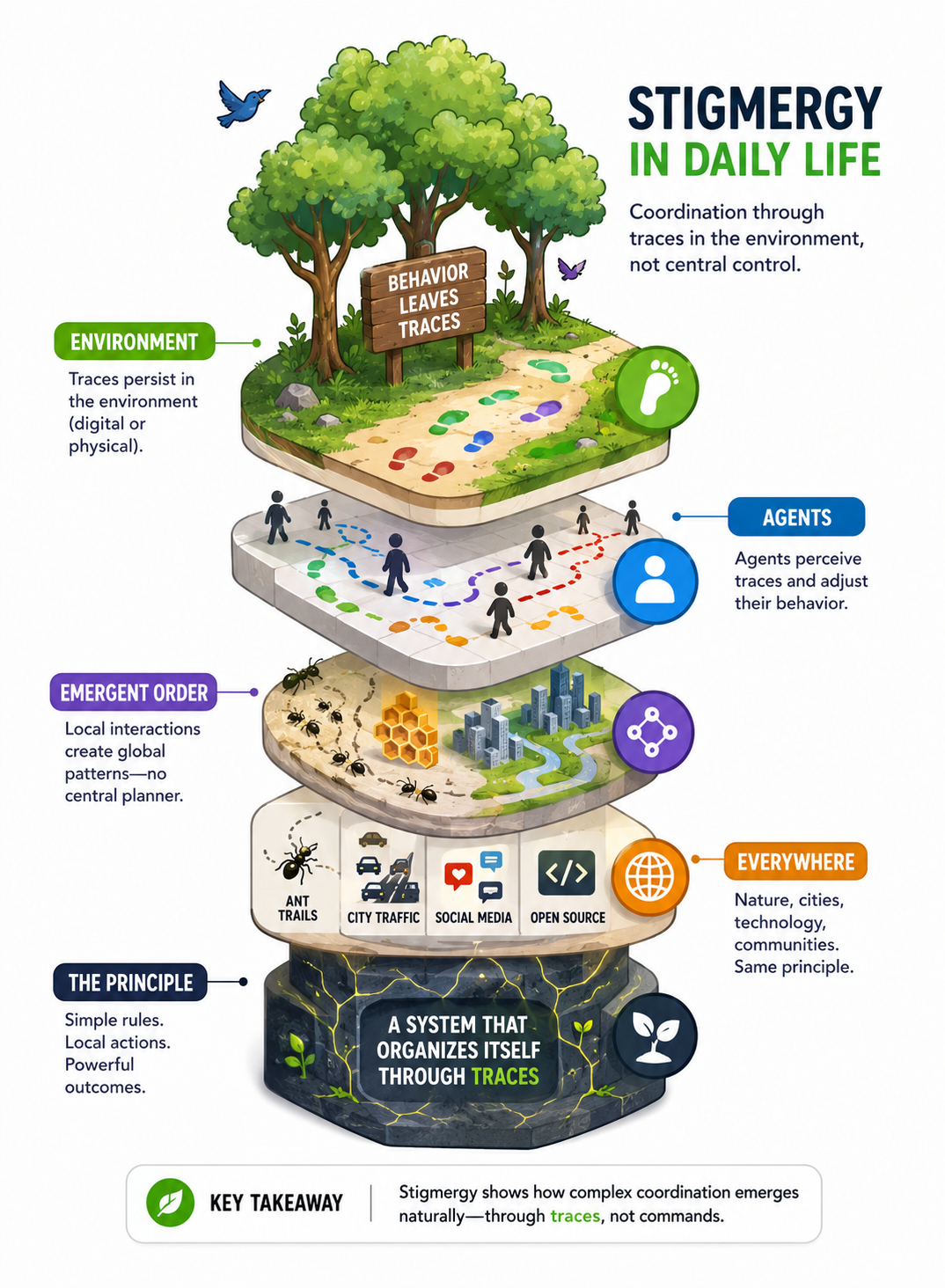
Humans coordinate, and even remember, mostly through traces left in shared environments — paintings on the wall, the layout of a kitchen, the pile of mail by the door, a worn path across a lawn. The trace itself does the cognitive work: when you re-enter the room, you re-load yesterday's intentions without re-deriving them. This is stigmergy: coordination via the environment rather than direct messaging. Every functioning home, office, and city runs on it. So does this repo.
L1 — Overview
Core question
What fraction of human coordination — within a household, across a workplace, across a city — is carried by traces in shared physical or digital space, and what is the compression ratio of those traces against the equivalent message-passing version?
Why it matters
- Direct messaging is O(N²) and expensive in attention budget.
- Traces are O(1) per recipient; a sign read by 1,000 people is one act of writing.
- Daily-life rituals (laying out tomorrow's clothes, sticky note on the door) are memory externalization. Understanding them clarifies how to design tools that extend working memory without burning attention.
- This repo's whole architecture (
git-as-shared-memory, lessons accumulate, files are communication) is stigmergy applied to AI sessions. Daily-life examples are the proof that the substrate works for humans too.
Mermaid map (L1)
flowchart LR
  actor[Person at moment t] -->|leaves trace| env[Shared environment]
  env -->|read by| actor2[Person at moment t+1]
  env -->|read by| other[Other people]
  actor2 -->|updates trace| env
  other -->|updates trace| env
  env -. compresses .-> identity[Identity / habits / agreements]
The loop has no central coordinator. Everyone reads the environment, acts, leaves traces, moves on. The environment is the protocol.
Skeleton sub-claims
- Memory externalization is universal. Most "remembering to do X" is carried by an object placed in a high-traffic visual location, not by neural recall.
- Painting / décor compresses identity. What a room displays is the inhabitants' self-model, replayed daily. It is cheaper to relive than to re-derive.
- Worn paths beat signage. Where people do walk shapes where the next person will walk; the gap between designed paths and worn paths is a measurement of design error.
- Bureaucratic forms are stigmergy with adversarial intent. They make the trace expensive to leave on purpose, to filter applicants. (Hooks into BUREAUCRACY-AND-AI.)
- The home is a compression of a life. This is the bridge to BRAIN-MEMORY-MANAGEMENT: finite working memory + cued recall = home setup.
L2 — Deep dive
Memory externalization in the home
Most of the things you "remember to do" tomorrow live in physical space rather than neural state. The keys go on the hook by the door because the door is the last thing you see. The pill bottle goes next to the coffee maker because coffee is non-negotiable. The pile of mail by the entryway is a reminder queue that you process when you walk past it.
This is not laziness or clutter — it is deliberate cognitive offloading. Working memory has ~7 slots; placing an object in a high-traffic visual location swaps slot-cost for environmental persistence. The room becomes a co-processor.
The cost is fragility under change: someone tidies the bottle into a cabinet and you forget the medication. Tidying is not neutral — it overwrites your externalised memory.
Décor as displayed identity
What a room displays — the photographs on the wall, the books on the shelf, the mug you reach for first — is not decoration. It is a compressed snapshot of who you take yourself to be, replayed every day at near-zero attention cost. You don't reconstruct your identity from scratch each morning; you walk through a room that has it laid out for you.
This explains why moving house is identity-disruptive far beyond logistical inconvenience. The compression artifact is gone. You have to re-encode, slowly, into the new space. Several months pass before the new home replays "you" again.
It also explains why tourists feel different from residents in the same city. The tourist sees uncompressed novelty everywhere; the resident has years of trace-overlay collapsing the same streets into a personal map.
Worn paths and the design-error gap
Walk across any university lawn and you will see the desire path: the diagonal line worn into grass between two paving stones that should have connected. The gap between the designed path and the worn path is a measurement — in dirt — of how badly the designer modeled human movement.
This generalizes far beyond landscape architecture. Where users actually click in a UI, where readers actually scroll, where employees actually walk for coffee — these are all worn paths. They expose intentions the designer suppressed. The mismatch is not noise; it is signal that the designed flow is costlier than the user's least-effort alternative.
The mistake is to fence the desire path. The fix is to pave it.
Adversarial stigmergy: forms as friction
A bureaucratic form is stigmergy turned adversarial. Where a sticky note exists to help you remember, a form exists to make your trace expensive enough that some applicants give up. The information being collected is often secondary; the cost of collecting it is the point.
This frame predicts which forms get longer over time (those gating high-demand resources), which get shorter (those gating low-demand ones, where filtering works against the agency's metrics), and where AI absorption hits hardest (the expression of the trace, not the requirement for one). See BUREAUCRACY-AND-AI for the post-AI residue.
Where stigmergy fails
Three failure modes recur:
- Time pressure exceeds inscription rate. If decisions need to happen in seconds, no one has time to leave a trace. Emergency rooms, combat, live broadcast. These domains compensate with ritual — pre-written checklists are previously inscribed stigmergy reused under load.
- Adversaries can read the trace too. A worn path tells a tracker you passed. A pile of mail at the door tells a burglar you're away. Stigmergy in security-sensitive contexts collapses into the worst-case reader.
- The medium decays asymmetrically. Sticky notes fall off. Sand erases footprints. Servers go down. When the medium fails faster than the message matters, the coordination it carried is lost — and you usually only notice when you go to read it.
Open questions
- What is the actual compression ratio of "kitchen layout" vs "explicit instructions to a guest"?
- Do digital traces (Slack pins, repo READMEs) decay differently from physical ones (sticky notes)?
- Where does stigmergy fail — what kinds of coordination cannot be carried by environment alone?
- Is the worn-path/designed-path gap a useful general measurement of system mis-design?
References
- (Pending L2 fill — Heylighen on stigmergy primitives is already cited at L-1296 in this repo.)
Inspiration sources
- The pattern is named in entomology (Grassé, 1959) but the daily-life extension to humans is folklore — every "lay it out the night before" trick is the same mechanism.
- Wikipedia's article on stigmergy is the obvious entry point and supplied vocabulary.
See also
- BRAIN-MEMORY-MANAGEMENT — working-memory limits make stigmergy necessary.
- UNIVERSE-EVOLUTION-AS-COMPRESSION — same mechanism at every scale.
docs/SWARM-RATE-DISTORTION.md— formal compression frame.docs/INSPIRATION.md— where this pattern is borrowed from.