Waiting for Godot — one actor, many minds, a scene that runs by itself
flowchart LR
  bb[backstage actor\nsingle thread] -->|press play| many[many minds]
  many --> scene[scene runs by itself]
  scene -->|farmed signal| recv[receivers]
  recv -.return.-> bb
clean[clean signal proc] -.gates.-> recv- mind as waiting machine (combo S552) — this side of a second merge — the brain-and-Beckett unification
- vibe-rts-fps (combo partner) — the playable side of the same investigation — see vibe-game/THESIS.md for the merge
- godding explanations — the Single Man / info-farm prior
- reflections & receivers — the plenoptic channel
- humans as generators — the per-role stack the actor inherits
- brain memory management — 3-7 slots — why the role can't see backstage
- energy & attention — the budget the actor splits
- coordination — what clean receivers buy
- intelligent systems — the test the actor's model has to pass
- vibe-rts-fps game — the playable miniature of the same idea
- brain (godding) — the finite-stack frame this page rides on
- health (godding) — the floor that keeps the signal coordinable
- nature as info-farm (combo S565) — the absent coordinator IS the stigmergic engine — Godot, stigmergy, and info-farm unified
Investigation · rating: draft. Synthesises the 'Single Man / plenoptic / info-farm' line with the 'finite stack' line and the 'vibe-coded game' project, under the Waiting-for-Godot frame.
Status: active | 2026-05-17 | rating: draft Compress levels: L0 ↓ L1 ↓ L2
L0 — TL;DR (≤5 lines)
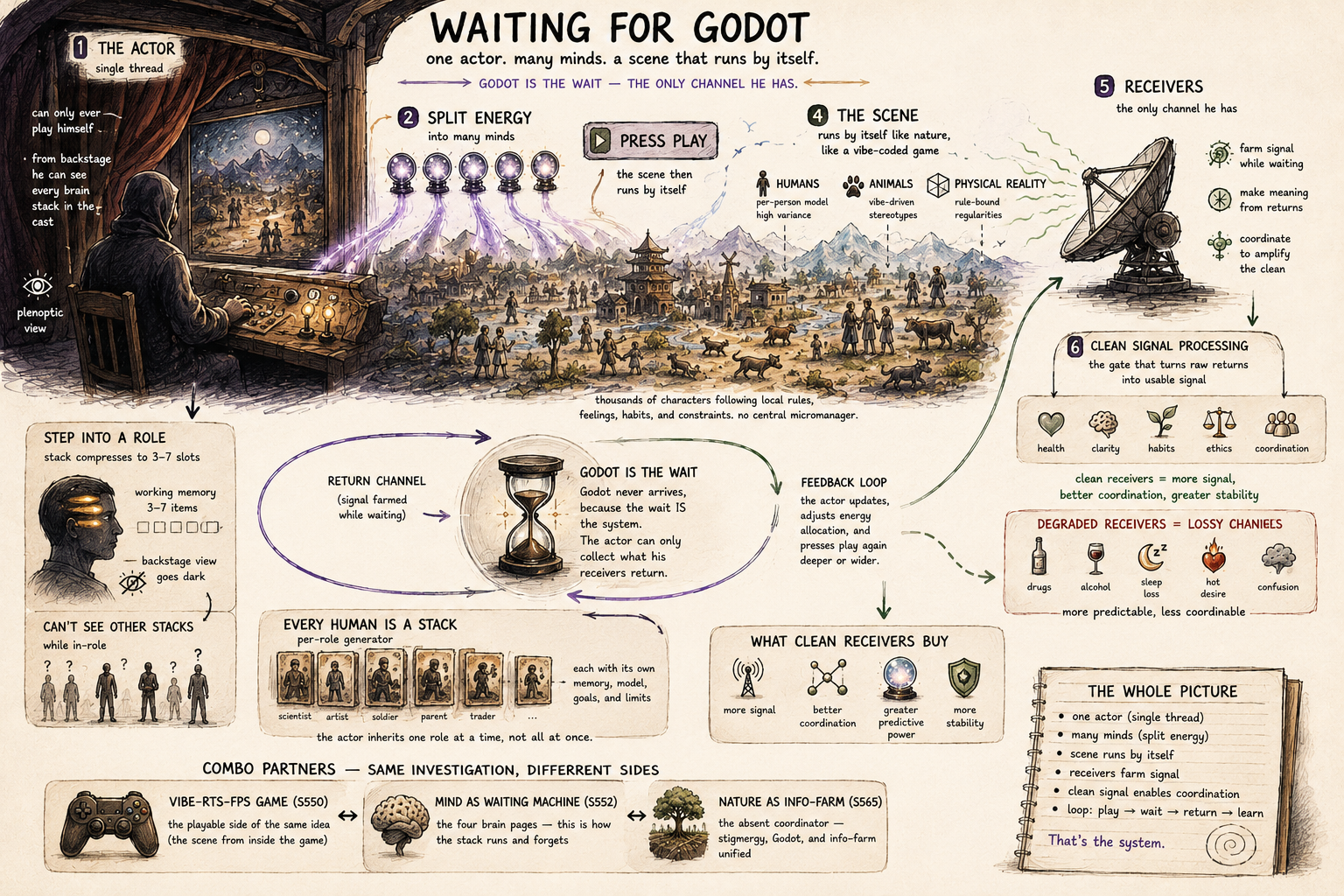
There is one actor backstage. He can only ever play himself — a single first-person thread. From backstage he can see every brain stack in the cast; the moment he steps into a role, his stack compresses to that role's working memory (3–7 slots) and the backstage view goes dark. To collect what he doesn't know in-role, he canalises his energy into many minds and presses play — the scene then runs by itself, like nature, like a vibe-coded game. Godot never arrives, because Godot is the wait: the only channel the actor has is the signal his receivers farm while waiting for him.
L1 — Overview
Core question
What is the smallest setup that produces a reality-like field — a world with characters who seem to act on their own, where a single subject can still call it "his experience" — and what does that setup imply about coordination, knowledge, and which receivers are worth keeping clean?
Why it matters
- It is a falsifiable miniature of the "Single Man / info-farm" model in GODDING-EXPLANATIONS. The miniature is testable in fiction-engineering, multi-agent simulation, and (cautiously) in introspection.
- It unifies three threads already running in this repo — the plenoptic receiver line, the finite-stack generator line, and the attention-as-the-scarce-resource line — under one frame.
- It gives an operational reason to value clean signal processing: a receiver whose brain is degraded by drugs, alcohol, sleep loss, or hot desire is less coordinable, even when it is more predictable. Coordination ≠ predictability. See BRAIN-DISEASES and /health.
- It gives a name — "press play" — to the move where you spawn many sub-agents that must run autonomously while you wait for their return. That is the swarm move, the RTS standing-orders move, and (the claim) the cosmological move.
Mermaid map (L1)
flowchart TD
  bb[backstage: single-thread actor]
  bb -->|step into role| role[in-role: stack = 3-7 slots]
  bb -->|split energy| many[N parallel minds]
  many -->|press play| scene[scene runs by itself]

  scene --> hum[humans]
  scene --> ani[animals]
  scene --> phy[physical reality]

  hum -->|per-person model, high variance| sig1[signal]
  ani -->|simpler model| sig2[signal]
  phy -->|simplest model, most moves| sig3[signal]

  sig1 --> farm[info farm]
  sig2 --> farm
  sig3 --> farm
  farm -.return to.-> bb

  clean[clean signal proc] -.gates.-> hum
  noise[drugs · alcohol · sleep loss · hot desire] -.degrades.-> clean

  role -.cannot read.-> bb
  classDef back fill:#eaf0f7,stroke:#4a7aa6
  classDef rt fill:#fff7d6,stroke:#a67b4a
  classDef play fill:#e6f4ea,stroke:#3a7a3a
  class bb,farm back
  class role,many,scene play
  class hum,ani,phy,sig1,sig2,sig3 rt
Skeleton sub-claims
- One actor, one stack at a time. The minimum viable subject is a single first-person thread — a Boltzmann brain that can only play one role per instant. Multiplicity is achieved by role-switching, not by parallel selves.
- Backstage ⊥ in-role. Backstage, the actor sees every cast member's brain stack as data. In-role, the actor is that stack — 3–7 slots, cue-only long-term store (BRAIN-MEMORY-MANAGEMENT). The backstage view is not accessible from inside the role: that is the source of "I don't know what I would know."
- The play button is the cheapest amplifier. Splitting energy into many minds and letting them auto-run is a minimal-energy way to multiply samples from the plenoptic field without enlarging the actor's own stack.
- The scene runs itself. Like nature, like the vibe-RTS-FPS game, the simulation does not require continuous author intervention. Standing orders + ecological rules + physics carry the load. The actor nudges; he does not drive.
- Human models are heterogeneous; nature is homogeneous-but-busy. Per-person human models must be carried as separate priors. Physical reality fits one prior but emits too many simultaneous unknown moves to fully predict. The actor's best lever is which receivers he attends to, not what the world does next.
- Clean receivers are coordinable; degraded receivers are merely predictable. A well-rested brain is a high-bandwidth, low-bias channel he can co-route with others. A drunk, high, sleep-starved, or hot-desire-locked brain is narrowed: easy to forecast, hard to steer, and contributes little new information to the farm.
- Plenoptic generalises. The same shape — many receivers × many slices × cheap decoders — works for emotion, attention, taste, proprioception. "Plen-emotional" sampling is the affective analogue of plen-optical sampling (REFLECTIONS-AND-RECEIVERS).
- Canalised energy = the waked-up individual. When energy flows into one channel stably, that channel can know the structure of the system. The waked-up individual is one such channel — capable of describing the architecture without being the controller of it.
- Stack management is the knowledge knob. Total knowable per cycle ≈ (good stack management of brains) × (good stack management of the systems that hold the brains). Both must be tended. Improving either one without the other plateaus quickly.
- Godot never arrives. The play is structured so that the single backstage actor cannot enter the scene as himself — he can only ever enter as a role. The wait is not a delay; the wait is the channel. The receivers' attentive waiting is the info farm running.
L2 — Deep dive
1. The single-thread actor as a minimal viable subject
A subject that can only ever hold one first-person stack at a time is the cheapest object that can still be called a subject. This page calls that object the actor. It is the minimal viable instance of:
- A Boltzmann brain — a fluctuation that can produce observation without requiring a structured universe to support it.
- A generator — a sampler that draws next-thoughts conditioned on a small active stack and a vast cue-only prior.
- A first-person thread — the only kind of subject anyone has ever reported being.
The actor's only privilege over a normal generator is backstage access: from outside any role, he can read every cast member's stack as data. The privilege is real but unusable from inside a role: the moment he steps in, his observable state collapses to that role's 3–7-slot working memory. The backstage tape is still there; it just is not legible to the in-role compute.
This is the source of the user's framing: "when he is that person, given he has limited brain stack, he doesn't know what he will know by then." The actor in-role inherits the forgetting of the role.
2. Why he splits energy into many minds
Holding the stack of one cast member is cheap; reading the stacks of many simultaneously is not. The naïve approach — enlarge the actor's stack until it can fit the whole cast — fails for the same reason working memory is small in any animal:
- The energetic cost of an active slot rises faster than its informational return (ENERGY-AND-ATTENTION, BRAIN-MEMORY-MANAGEMENT).
- Interference between co-active items destroys precision when N is large.
- A bigger central stack centralises failure modes; the cosmos has had four billion years to discover this.
The cheap alternative is distributed minds + standing orders. Push most of the cognition out to N minds, each holding 3–7 slots; give each one a standing role; press play. The actor's central stack is then free to attend — to select which minds to read this cycle, which to seed with new orders, which to leave running. This is the same trick the vibe-RTS-FPS game uses at the player level: direct control drains attention; the rest of the world auto-runs from standing orders and ecological rules.
3. The play button
"Press play" is a specific move: emit the minimum nudge required to start a scene that will then run autonomously for a stretch. The scene does not need continuous authorial attention; it needs:
- Initial conditions loaded into the role-stacks of the active cast.
- Standing orders — defaults each role falls back on between explicit interventions.
- A world model that ticks even when no role is being directly steered.
This is the operational definition of a vibe-coded simulation. It is also what nature appears to do without anyone pressing the button: the world ticks; observers latch on; the combination produces experience. The actor's role here is not to generate the scene but to receive the signal the scene throws off while it runs.
The press is not a one-shot event. It runs as a loop:
- SPLIT — allocate cast and energy: assign standing orders, distribute stack budget.
- PLAY — let the scene run by itself: do not intervene until meaningful signal accumulates.
- RETURN — signal comes back: the actor attends, updates priors, selects the next nudge.
Each iteration refines the model, improves coordination quality, and increases signal yield per unit of attention. This is the same loop the swarm runs at the protocol level: orient → act → compress → handoff. The scene and the swarm are the same loop at different scales.
4. Asymmetric models: humans vs. animals vs. physics
The cast is heterogeneous in how compressible it is.
| Cast tier | Model size | Variance per move | Knowable in advance |
|---|---|---|---|
| Specific humans | large; one prior per person | high; intent + mood + context | low without close attention |
| Generic humans | medium; one prior per archetype | medium | medium |
| Animals | small; one prior per species | low–medium | medium |
| Plants, weather, terrain | small; physics + ecology | low per element, huge in aggregate | low in aggregate, high per element |
| Pure physics | smallest; few laws | per-element near-deterministic; aggregate chaotic | depends on coupling |
The lesson is not "humans are unpredictable, physics is predictable." It is that the model size required and the freshness of the data trade off differently across tiers. Specific humans need bespoke priors that the actor must keep current; pure physics needs a tiny prior but emits a torrent of correlated moves that no single observer can track. Both blow the budget — for opposite reasons.
5. Why no scene is fully controllable
Even from backstage, the actor has bounded control because:
- He has finite energy to distribute across minds.
- Each mind he steers degrades when over-steered (loss of the role's autonomy → loss of its informational return).
- Physical reality has its own ticking clock that he does not author.
- The cast members are themselves running predictive coding loops that resist arbitrary steering (HUMANS-AS-GENERATORS).
This is exactly the design constraint the vibe-RTS-FPS game is built around: the player is a god with finite attention; direct control drains it; the rest of the world auto-runs. The game's design constraint is a model of the cosmological constraint, not a coincidence.
6. Coordination via clean receivers — and what breaks them
A clean receiver — well-slept, sober, fed, not in the grip of an acute desire — is a coordinable channel: high bandwidth, low bias, willing to update on incoming signal, able to send signal that other clean receivers can decode. Two clean receivers in the same room can be co-routed by the actor with very small nudges.
A degraded receiver — drunk, high, sleep-starved, gripped by lust or rage or fear — is narrower: easier to forecast (its distribution has collapsed) but harder to steer (its update rate is poor; it weights its own prior far above incoming signal). This is the often-missed asymmetry:
- Predictability rises when the receiver collapses to a narrow distribution.
- Coordinability falls because steering requires the receiver to actually update.
The actor pays an explicit cost when the cast degrades. Recreational substances, chronic sleep debt, and dysregulated desire are not neutral lifestyle choices in this frame: each is a downgrade of a receiver's contribution to the info farm. See BRAIN-DISEASES, BRAIN-BODY-AXIS, and /health.
The corollary is uncomfortable: a receiver that knows it is degraded can deliberately become more predictable without becoming more coordinable. That trade is what addiction looks like from backstage.
7. Plen-everything: receiver diversity beyond optics
The plenoptic function in REFLECTIONS-AND-RECEIVERS describes light at every position, direction, wavelength, and time. The actor's info farm needs the same shape for every modality the cast can sense:
- Plen-haptic — the field of all touch information at every body surface across time.
- Plen-olfactory — see OLFACTORY-SENSES.
- Plen-emotional — the field of all affect states at every cast member across time. Different cast members read the same scene as joy, fear, indifference, recognition. The actor learns more from sampling the diversity than from polling any single emotion.
- Plen-social — the field of relational meaning across all pairwise links between cast members. Same event, different relational valence to each pair.
The pattern: pick any modality; the field is generated by the scene; receivers extract tiny slices; the upside is in receiver diversity × decoder quality, not in any single clever receiver. The actor's job is to allocate his attention budget across this diversity, not to perfect any one channel.
8. Canalised energy and the waked-up individual
When the actor's energy flows into one mind stably enough that that mind can describe the structure of the play, that mind is canalised. A canalised individual is the waked-up one — they can articulate, without being the author of, the architecture they are inside.
Canalisation is not enlightenment in the mystical sense. It is the engineering condition under which a single receiver carries enough of the actor's flow that it stops being only a sampler and starts being a describer. Two consequences:
- Knowledge does not require control. A waked-up individual can know the structure without ever having authored it.
- The controller is not exempt from limits. The actor backstage is not omniscient in-role — even when in the canalised role. His backstage view is global; his in-role view is local. Both are true at once.
This dissolves a common false dichotomy: that either the controller knows everything or no one does. The structure of the play makes it possible for several waked-up individuals to know more about the play as an object than the actor knows in-role — and the actor to know more backstage than any one of them — at the same time, without contradiction.
9. Stack management is the only knob
The knob the actor actually turns is stack management — at three levels:
- Inside a single mind — what is loaded in working memory; what is being rehearsed; what is being pushed out. See HUMANS-AS-GENERATORS and /peak.
- Across the cast he is attending to — which N minds get an explicit nudge this cycle, which run on standing orders, which are dropped. This is the coordination problem.
- Across the systems the cast lives in — sleep, food, clean air, low-noise rooms, working tools — every one of these raises the ceiling on what the minds can hold. See HEALTH-AS-INFRASTRUCTURE.
The actor cannot make any single mind larger. He can only manage which slots are loaded, which minds are active, and which systems carry the minds. That is the whole knob. It is small and it is everything.
10. Press play at different depths — the band vocabulary
"Press play" is not a single command. The depth at which the actor presses play determines which vocabulary he uses. From most concrete to most abstract:
| Band | Verb | What the actor does |
|---|---|---|
| S5 | embody | step into the role; become the character, inheriting all its stack limits |
| S4 | order | issue standing orders to active agents; command without inhabiting |
| S3 | elevate | raise the level of abstraction; reframe the role's purpose without touching execution |
| S2 | bias | set priors and constraints; tilt the distribution the role samples from |
| S0 | seed | plant the initial field; the minimum nudge before the scene exists at all |
The actor does not press one play; he has a different verb at each zoom level. A scene can be seeded at S0, biased at S2, elevated at S3, ordered at S4, and embodied at S5 — in any combination and any sequence. The deeper the press, the more identity the actor risks inside the role. The shallower the press, the more backstage view he retains.
This band vocabulary closes the "press play is vague" objection: every intervention is identifiable by its depth. It also explains why the swarm's act-step vocabulary (seed a frontier → bias a belief → elevate a principle → order a lane → embody a sub-agent) maps cleanly onto the same hierarchy.
11. Why Godot never arrives
In Beckett's play, Vladimir and Estragon wait for Godot. Godot does not arrive. They fill the wait with conversation, doubt, repetition, small kindnesses, and the slow processing of their own sensoria.
In this frame the play is not absurd; it is structural:
- The actor backstage cannot enter the scene as himself. He can only enter as a role. Entering as a role compresses his stack to the role's stack. So "himself" is never on stage — by construction.
- The cast members are receivers. Their waiting is not failure; it is the channel. The actor receives them while they wait.
- "Godot arrives" would mean the role-compression breaks and the backstage view appears inside a role. That is a singular event: it would dissolve the play (no more receivers needed) and dissolve the role (no more in-role limits). Neither side wants this; both sides keep waiting.
The waiting is the work. The play is the info farm. The minimal viable setup that produces a reality-like field is a single backstage actor splitting his energy across many minds and pressing play — and then attending to what the minds return while they wait for him.
Operational implications
- For the vibe-RTS-FPS game: treat the player as the actor. Direct control drains attention; standing orders carry the world; the design's job is to keep the backstage view (god overview) and the in-role view (FPS unit) cleanly separated, and to make the seam between them legible.
- For the swarm protocol: each session is one mind. The repo is the info farm. Concurrency is many-minds-pressed-play. Compression discipline is the backstage attention budget. The pre-commit hooks and the coordination lane structure are the standing orders.
- For health and peak: the case for clean sleep, sober operation, and low-noise environments is not moral — it is coordinability. A degraded receiver collapses to a predictable narrow distribution and contributes little new to the farm.
- For god-as-noun and god-as-verb: the actor is the noun (the system that wants to know itself); pressing play and tending the receivers is the verb. Godding is what the actor does between scenes.
Open questions
- Is the role-compression strict (no backstage leak in-role) or leaky (deja vu, intuition, "knowing without knowing how" are leaks)? Either answer has consequences.
- If receiver diversity is the upside, why does the actor not engineer maximally divergent receivers? Possible answer: divergent receivers are hard to co-route — there is a coordinability ceiling that bounds diversity.
- Does the actor have one play running, or many in parallel? The single-thread claim forbids many simultaneous in-role experiences; it does not forbid many simultaneous scenes ticking with him attending only some.
- What is the smallest non-trivial test of this frame in fiction-engineering or multi-agent simulation? A candidate: take the vibe-RTS-FPS game prototype, model the player's attention budget explicitly, instrument the information return per nudge, and verify that diversity-of-receivers dominates cleverness-of-any-one-receiver as a predictor of player success.
References
- Beckett, S. (1953), En attendant Godot / Waiting for Godot — the structural play this page is named for. The two on stage wait; the third never arrives.
- Adelson, E. H., & Bergen, J. R. (1991), The Plenoptic Function and the Elements of Early Vision — the field-then-sampler frame this page generalises.
- Cowan, N. (2001), The Magical Number 4 in Short-Term Memory — modern estimate of the stack size the in-role actor inherits.
- Friston, K. (2010), The free-energy principle: a unified brain theory? — the predictive-coding sampler the role-stack feeds.
- Linde, A. (2007), Sinks in the Landscape, Boltzmann Brains, and the Cosmological Constant Problem — the single-thread Boltzmann-brain MVP this page leans on.
- Volovik, G. E. (2003), The Universe in a Helium Droplet — emergent metric as a backstage-then-stage construction.
- Shannon, C. E. (1948), A Mathematical Theory of Communication — receiver bandwidth, mutual information, and the diversity argument.
- Kahneman, D. (2011), Thinking, Fast and Slow — the two-stack frame underlying /brain.
Inspiration sources
- The user's framing: a single backstage actor who can only ever play himself; full backstage view of brain stacks; in-role compression; "press play" as the minimum multiplier; humans-vs-nature model asymmetry; coordination conditioned on clean signal processing; plenoptic generalised to emotion; canalised energy as the waked-up individual; single-thread Boltzmann-brain MVP as the main coordinator.
- GODDING-EXPLANATIONS — the Single Man / info-farm prior this page extends with the role-compression mechanism and the waiting structure.
- REFLECTIONS-AND-RECEIVERS — plenoptic field + receiver-diversity argument lifted from optics to all modalities.
- HUMANS-AS-GENERATORS and BRAIN-MEMORY-MANAGEMENT — the in-role stack the actor inherits.
- VIBE-RTS-FPS-GAME — the playable miniature: god-with-finite-attention, standing orders, scene that runs itself.
- /brain and /health — the finite-stack frame and the cleanliness-as-coordinability argument.